Forty-five minutes before the sun comes up, the river does something almost no one sees.
I know because I am usually alone out there when it happens. A pink band settles on the horizon and the water mirrors it back; the pier cuts straight through the middle of the vibrant color, and I stand on cold sand in the dark feeling like I have been let into heaven’s waiting room early. Some mornings, the fog takes the Coleman Bridge entirely, dense gray where two a half mile of steel ought to be, and I stand in awe of the hidden architecture. Other mornings, the clouds tip pink and purple before the sun has made any appearance at all, and I want to disappear into the morphing color, press a pause button, suspend the scene, and keep it longer.
When I started this, I thought the sunrise was the moment the sun cleared the horizon. That is what I came for. It took me a while to understand that the real gift arrives three quarters of an hour earlier, and that most people are still asleep for it.
I’ve been going for two years now, and it’s still the best part of my day.
Sunday morning at church, we sang a song called “Christ Be Magnified,” and the first line held meaning it had not before: “Were creation suddenly articulate…”
I was overwhelmed. There with flashes of the water’s edge filling my mind. For me, it is already articulate. It’s been talking for two years.
We say there are five love languages. I have come to believe there is a sixth, and it is what creation speaks at first and last light. The physical world actually does declare the glory of God, and it is not a figure of speech to me. It speaks the same language as my soul.
Would you believe I’d rarely caught a sunrise in my adult life before this practice?
Every year, I felt summer slipping away in September and started dreading the leaves turning because I knew what came after was a barren winter and a scarcity of light. I was a night owl who slept until the last possible minute and then white-knuckled it from November to March.
Two years ago, I started going to Yorktown Pier at sunrise. It was weekends only at first, but after I finished writing my first manuscript and went back to teaching full time in January, I was going every day. In essence, it was the first winter in my memory that the blues did not bring me low. I wrote about the medicine of it in my book: that a person with a mood disorder can establish a circadian rhythm and that light at consistent times is not a nice idea but a clinical one. Seasonal depression is real and treatable, yet most of us never hear that there is anything we can do besides endure it.
I had more than a year of that routine banked when the world fell out from under me this past February.
I credit it with my survival. I’m not being poetic. The routine was already load-bearing by the time I needed it to hold weight, and God met me at the water’s edge every single morning after. He had already positioned people there — herons and fishermen and walkers and photographers — so that I had somewhere to go that was full of life in stark contrast to the sudden silence waiting at home.
This morning, I ran into a woman named Sadie.
I met her a year ago, right before she moved away. She came back. She said she felt called back, which I understand better than most people would, having left for South Carolina in 2022 and come home in 2023 myself. She remembered my story.
We stood at the water well twenty minutes before the sun rose and talked about what this routine does for a soul. She had been figuring it out on her own while she was gone, arriving at the same conclusions I did, and she intends to keep doing it. She doesn’t need a camera to take the light with her. She comes to be in it.
I am not sure I would know what to do in a sunrise without my camera anymore.
On Sunday evening, my camera went into the bay and made that a real possibility.
I had been at Fort Monroe all afternoon shooting a scene in a friend’s independent film, so I stayed for the sunset. I worked the Fort, then went down to the marina. A man waved me onto his slip just as the sun was going. I set up my tripod at the end of it. He came out to join me, and we started talking.
He told me he used to take pictures. Now, it is watercolor. He said that is why he bought the boat — to paint the skies and the seas. The sun had set by now, so no longer rushed to catch that last glimpse, I turned my attention to the man behind me.
I took my strap off my neck and turned around to shake his hand and ask his name.
The slip is not steady. I heard him say, “Oh,” and watched his eyes registering what was happening before I heard the splash. The tripod was already fully submerged, but I knelt low and reached in, caught the neck strap, pulled the whole thing out; it was already too late.
His name is Pino.
I was a hot mess. The version of this story where I am gracious in a crisis is not the version. I said out loud, to a stranger, “This camera was my life, my life just went overboard, and I do not know what to do now.”
He did not laugh at me or tell me it was only a camera or call the cops for someone having a mental health crisis. No, he said he understood. He said the watercolors on his boat are all he has.
Two lonely souls standing in an afterglow neither of us could photograph.
He got hold of a photographer friend of his that night and called me back to tell me exactly what to do with the equipment before anyone could look at it. He texted again today to check on me. Pino invited me back. I’m glad to have met him. It feels like I’ve inherited a grandpa figure to add to my collection of God’s provisions.
It has only been three days, but it felt like considerably more than three days from the inside.
Yesterday, my friend Dave met me at the pier with his mirrorless camera and spent the sunrise coaching me how to use it. I am not sure I would have gotten out of bed if he had not been coming. Another friend Graham offered me his camera to use until mine is fixed or replaced, and I could not take him up on it because after watching my own go into the water, I was hesitant to be responsible for anybody else’s. My mentor called to walk me through repair and replacement options.
Last night and this morning, I shot with an old base body and scratched lens which produces blurs I must edit out one at a time.
Two sunrises without my Canon. That is the catastrophe, laid out sadly.
When I write, I grow, and tonight I see something I think I got wrong on Sunday night.
I said my camera was my life. It is not. Whether or not there is a camera in my hands, God is going to make the sun rise and set, and He is going to give light, and it is the light I actually need. The camera is only what gives me a reason to linger — to stay out there shooting and then come home and spend another hour editing and then put it where other people can see it.
I borrow the light. I give it away.
Ultimately, what broke me on Sunday was not the loss of equipment. It was the sudden possibility of not being able to share it. Sharing it is what gave this practice a purpose beyond keeping me upright.
In February, I borrowed the light to survive.
In June, when I started posting a sunrise and a sunset every single day, I started borrowing the light to share it.
And yesterday, I borrowed somebody else’s camera to keep doing it. Borrowed camera to borrow light.
One more thing, and then I will let the October reel speak for itself.
I have been thinking about going mirrorless for months and finding reasons not to. I am such a creature of habit that I could not imagine my hands on a different body. Then, I shot with Dave’s, exhausted and grieving and barely functional, and I came away with what might be the best heron frame I have ever created. What you see on that screen is actually how the shot is exposed. Less guesswork. Fewer frames. Better files.
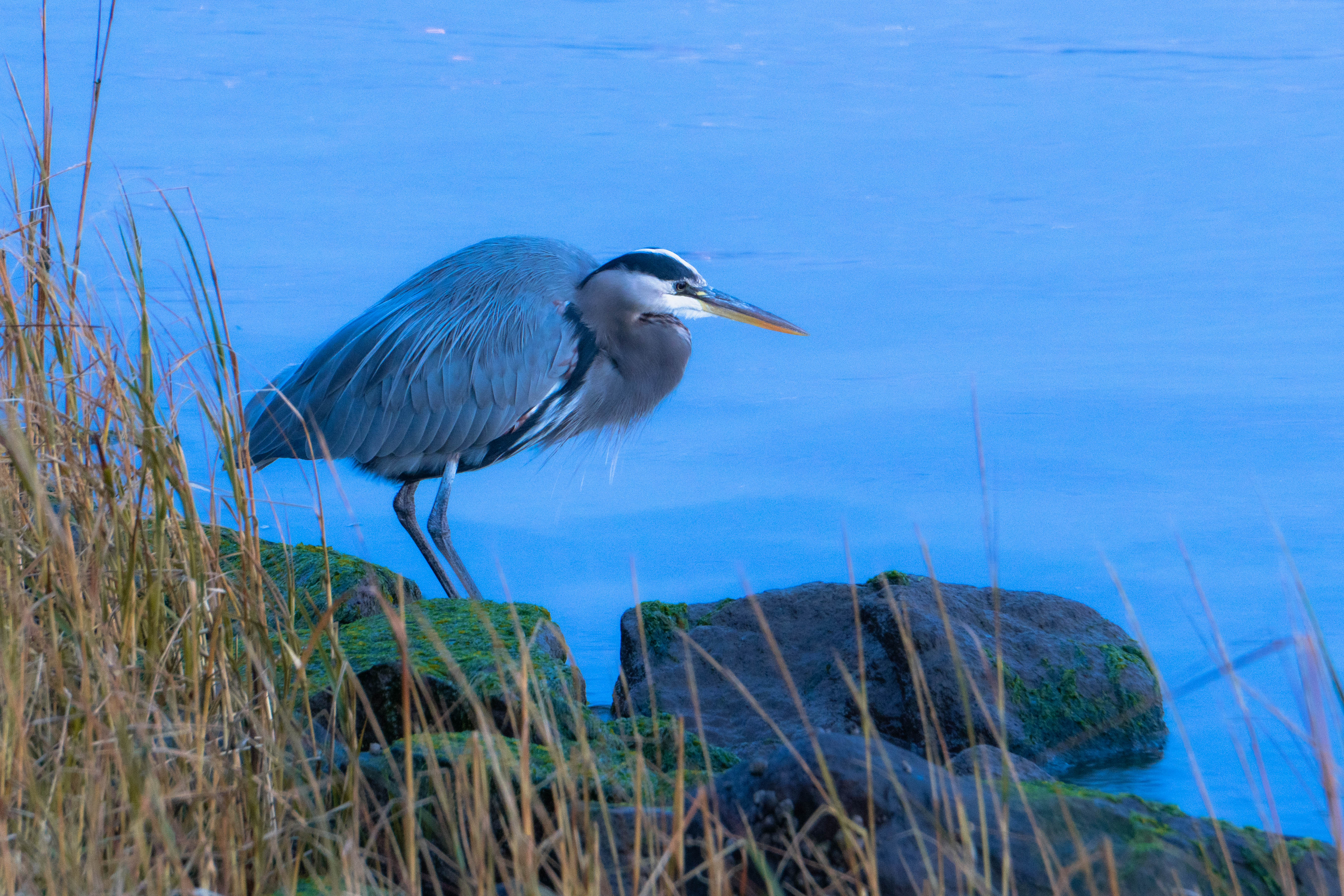
When I posted the set, Nancy commented, “Time to go mirrorless.”
Maybe that is what all of this was for. I would never have made the change on my own. It took meeting Pino, and him welcoming me onto his slip, and me stopping mid-shot to turn around and learn a stranger’s name, and a tripod going over into the Chesapeake with my best lens on it.
I won’t claim I know that for certain, but it is the kind of thing He does.
There is less light in Hampton Roads between now and March. That is an inevitable reality, and if you live with a mood disorder, you already feel it coming.
Well, I will take what there is. Two to three hours of it every day, split across both ends, and then more hours at a screen giving it away.
The October reel below is thirty-one sunrises I showed up for where creation was articulate. Majesty, might, awe, and wonder. The camera that took them is in pieces in a shop, but the photographs live. The light didn’t go into the bay.
I borrow the light. I give it away. And tomorrow morning, I’ll go borrow some more.

