The colors keep changing, and I with them. Soon the maples will shed their leaves entirely; we’ll bring pine trees inside and sprinkle the neighborhoods in twinkling lights. This holiday season sits between me and testifying at a grand jury trial, and it seemed fitting our new sermon series in John is on how to suffer well.
On Sunday, Pastor Colin preached from John 18:1-27 on the betrayal and arrest of Jesus. This passage begins the most unjust 24 hours in human history, and yet Jesus steps forward freely, authoritatively, and lovingly. He is betrayed by his ordained system and by his greatest friend.
Key takeaways: The kingdom is not advanced through human means. The kingdom is advanced through great suffering. Then, God redeems and uses the suffering for good. Oh, just oh, how true that is.
Victimization need not become identity; suffering need not have the final word. God is the author of redemption. I felt like he was talking to me. “Your story will never be redeemed if you forever remain a victim, when that becomes the thesis of who you are,” Pastor Colin said. “Don’t deny what happened. The gospel refuses to let what happened define us.”
I suppose that is why I abandoned my original Sanctuary in the Storm manuscript. It began on February 1, the night that destroyed the sweet life I thought I’d been building in Yorktown. It relived the nine most unjust days I’ve known, nothing compared to what Jesus endured in the garden. Like him, I was betrayed by my best friend. Like him, this suffering became the platform for a redemption story.
October was the awareness month for Domestic Violence. November is for Strangulation. The Facebook algorithm knows I care. My feed is full of sunrise and sunset photos from fellow photographers punctuated by statistics about intimate partner violence and narcissistic abuse.
But scroll my feed. Google me. Scour my blog posts. As a memoirist, I’ve built a brand around writing authentically about my life to inspire and connect others with something beyond themselves. I refused to let what happened that night become the thesis of who I am. The gospel refuses to let that night define me, and so I started a new manuscript this summer, and it begins when the sanctuary did. Chasing the light at the water’s edge with a camera in a sundress.
In the spring months, I’d close my eyes and return to that one night. I was stuck in it, reliving it in my dreams. In EMDR therapy for PTSD, we relived it on purpose. When we were done processing February 1, I stopped letting myself return there.
And since that night, I have watched 280 sunrises and 147 sunsets. I captured the light change 427 times. And it changed me every single time. One sky over a river at a time, God was filling my mind with memories of glory and majesty, not mine but His. When I close my eyes, I don’t see the injustice or betrayal in my bedroom anymore… there are scores of scenes of first and last light instead, what I caught with my camera and what happened on the shore beside me.
I would not have chosen a path of suffering, and yet I am not the same woman I was on February 1. I have less in many ways but have become more. One of my mentors responded to that saying, “…and you won’t be the same on 2-1-27. Pain enhances growth and suffering is often a blessing (usually in retrospect).” Truer words haven’t been spoken.
When this year began, I took photos of the sunrise rather selfishly. I kept a record of what the river did every morning, just files in folders filling a hard drive. I’ll always be grateful for the folks who encouraged me to start sharing them in June. I took my suffering to the water’s edge and God transformed it into something beautiful.
God writes beautiful stories with suffering. If you love me, you know my camera is an extension of me. When I dropped it in the Chesapeake Bay last week, I felt the loss. So did some of you. And that’s precisely why God gets to write a good story. People are paying attention. I thought upgrading to a mirrorless camera was the silver lining of my tripod tipping off a slip at Fort Monroe.
But really, it was Pino, the retired Italian watercolorist who’d let me on his slip that night. He reached out last week and asked, “Would you like to display your photos at the gallery?” He meant the little spot on Mellon Street I’d walked by a hundred times. Was he for real? I met him on Saturday at Fort Monroe to find out; he took me to the gallery on Phoebus, showed me his wall of watercolors, introduced me to the director, and took me to lunch at Stuft where we found a familiar rhythm that felt an awful lot like spending the day with my Italian grandfather. My favorite moment was explaining my first book to him, Fearfully, Wonderfully, and Bipolar-ly Made. “So you’re two people?” I laughed.
I explained to him with hand motions how living with bipolar disorder puts you on this spectrum of emotions, and in the middle is euthymia, neutral and calm… the state we live to maintain. Hypomania, mania, depression, and major depression are steps away from that middle spot. I told him to look at me now, smiling and laughing. Then, remember me at the end of the slip saying, “That camera was my life. My life just went in the bay.” It takes me longer to regulate my emotions, longer to get back to the middle when I’ve been triggered by something.
He thought that I was just being Italian. It’s so sweet and rare to be accepted as you are. Pino stood beside me as I shot sunset at Fort Monroe again that night… and kept my camera strap on.
So many people have entered my life at the water’s edge this year. Some were already there when I needed somewhere to go. Others have appeared along the way, each bringing something I couldn’t have anticipated. I went to the river to watch the sun rise and set. I did not expect to find a community, a support system, a reason to keep getting up each day.
Four continuances carry the criminal case into the next calendar year. Justice delayed. Closure evaded. When summer started, I was still living from court date to court date. Now, God has acclimated me to a new normal. I type the date twice a day to label the photo shoots at sunrise and sunset. The days do not pass by. I count, collect, and savor them. If you watch the light change 427 times, it will change you. You’ll measure joy in scattered clouds instead of kisses. You’ll find that small, orderly world you were building inside just cannot compare to the glory of God.
I can test this. I did it today.
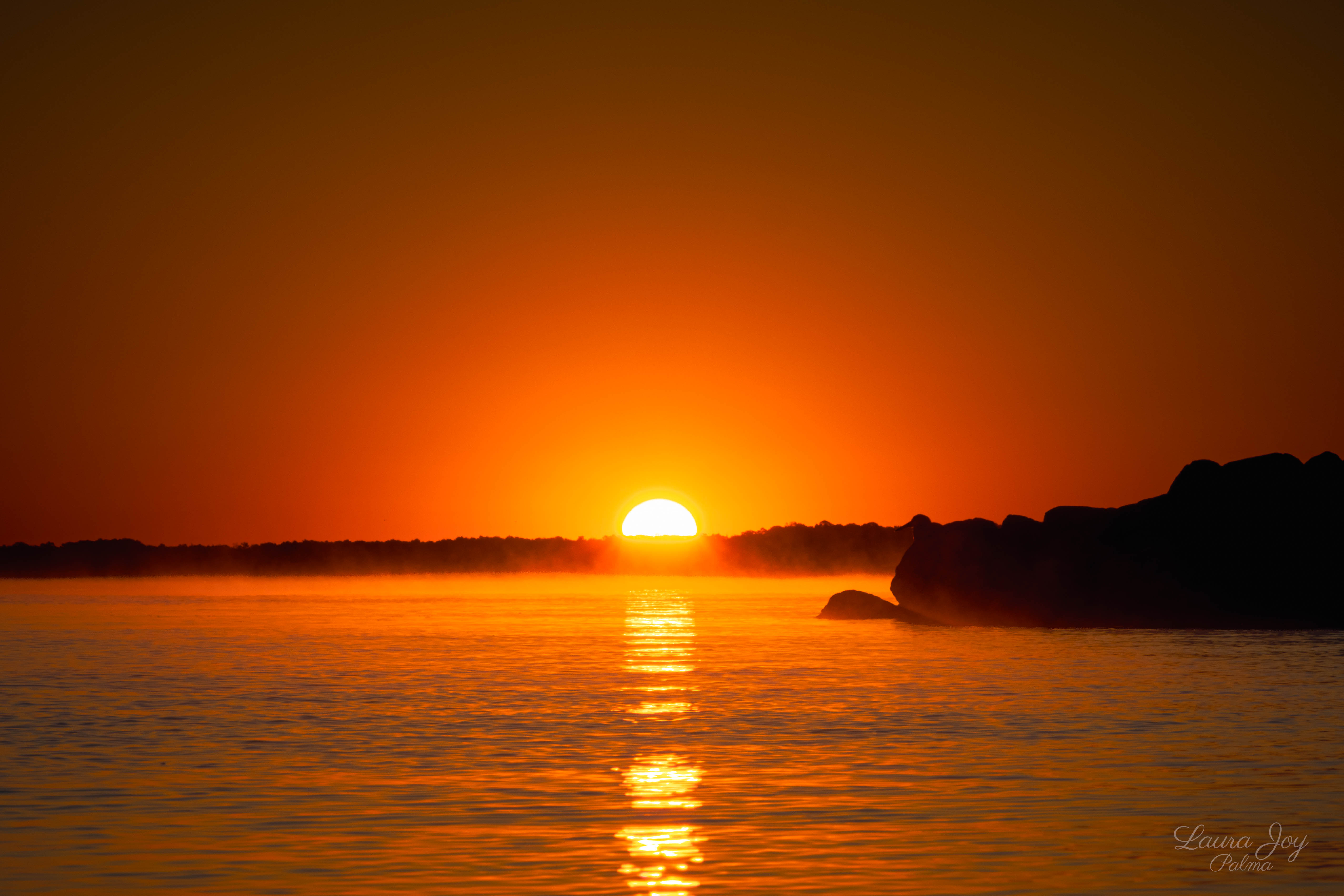
This morning, the forecast said clear and I expected a thin, ordinary sunrise. I didn’t pray for anything. It was forty degrees, cold enough to catch the river’s breath, and God made fog instead. It cut the disk and let me shoot far longer than a clear morning allows. Psalm 135 was in my head: whatever the Lord pleases, He does. I can’t make clouds. I can’t make haze. He made fog.
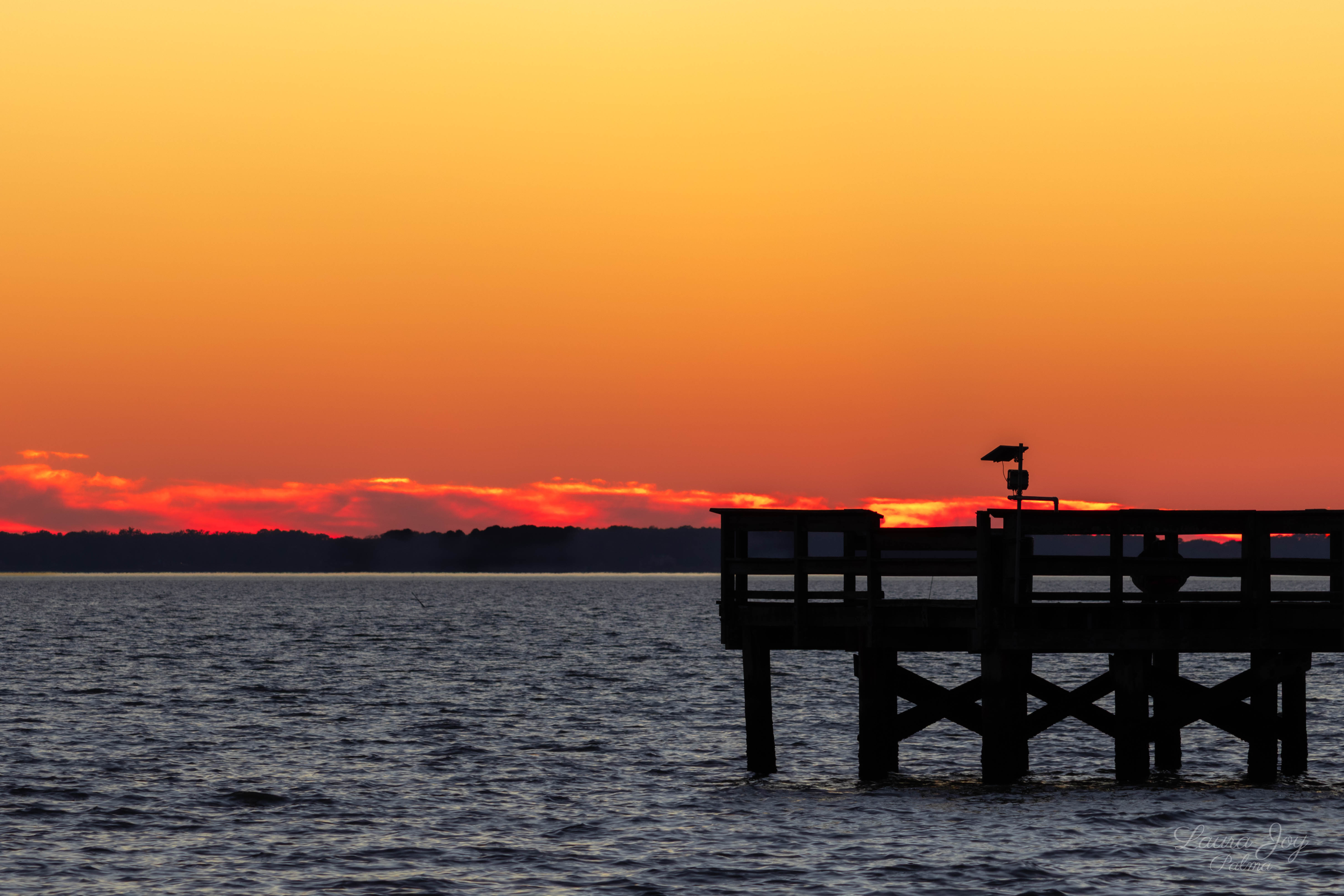
Tonight, there wasn’t supposed to be a single cloud. I prayed for one anyway, and then I studied the atmosphere the way I do every day and picked the spot with the most potential and drove to Hilton Pier.
There were tiny, low-hanging scattered clouds hugging the James, just to the left of where the sun went down. They turned pink and then orange and they sat behind that long closed pier for a long time after the sun was gone.
I asked for scattered clouds this afternoon. He gave them to me by evening. Joy in a sunset.
Someday, I will share the story of what happened on February 1, but when I do, it will be part of a redemption story. I won’t build a platform on domestic violence, but I’ll build it around the God who posted me at the water’s edge to save me after it. I want people to know what happened, certainly. More than that, I want them to know what God did next. The thesis of who I am is a woman redeemed.

