There were dolphins at sunrise this morning.
I was set for long exposures, shutter speeds too slow to catch anything moving, so I didn’t even try. I stood on the pier and watched them arc through the pink glow, then saw a deer cross the road behind me. I thought about how, a year ago, almost to the day, I journaled that dolphins at sunrise were a good sign.
By that night, I was sick. By that Friday, I was home alone while homecoming happened without me.
The King Tide came back this month, too. It swallowed the beach the same way it did last October, the way it does every year when the full moon pulls the water up over the brick. The sun has traveled all the way around the horizon and come back. It no longer sets behind my cypress at Jamestown, and it now rises behind a tree by the picnic tables I walked past for two years without seeing.
Everything comes back around. I’ve been writing this blog long enough now to watch the wheel make a complete revolution.
Well, everything except one thing.
On Friday night, a night that once would have been a date night, I wanted excitement. I saw scattered clouds in the forecast and knew where I was headed before I finished the school day. I returned to the lions.
Lions Bridge is one of the spots in my sunset rotation that holds no memory of him. We never went there together. Every frame I’ve taken there is mine, made alone, with nobody’s mood to read but the sky’s. I’ve photographed those four stone lions in fog and fire and gray. I’ve climbed on them and found the cracks in their tails. Not one of those evenings has a ghost in it.
And Friday, for the first time, I could not get my husband out of my mind.
I knew Wednesday was coming. I’d known for two months that I would see him again, and the knowledge sat on me the entire evening. The light was extraordinary anyway. The sun played peek-a-boo through the clouds and did things I could not have planned for, so I worked. I shot my original lion and set the thought down. I moved to the second lion and framed the overlook behind him and set it down again. Half a dozen pelicans came through fishing. Three herons stopped on the shoreline long enough to let me photograph them, and I chased one of those shots with a longing in my chest I did not know what to do with, and I got the frame.
What this fall is teaching me, if anything, is that the practice is not designed to make me stop missing him. I put it down, picked up the camera, put it down again, and God continued to offer a free color and light show to soothe the frazzled edges of my soul.
Another photographer out there that night took a picture of me capturing the sky. I’m wearing a red sweater dress that goes to the ground, with pockets, because the weather has turned and the sundresses are stored until spring. My camera is up. My back is to him. You cannot see my face. You would never know what I was carrying.
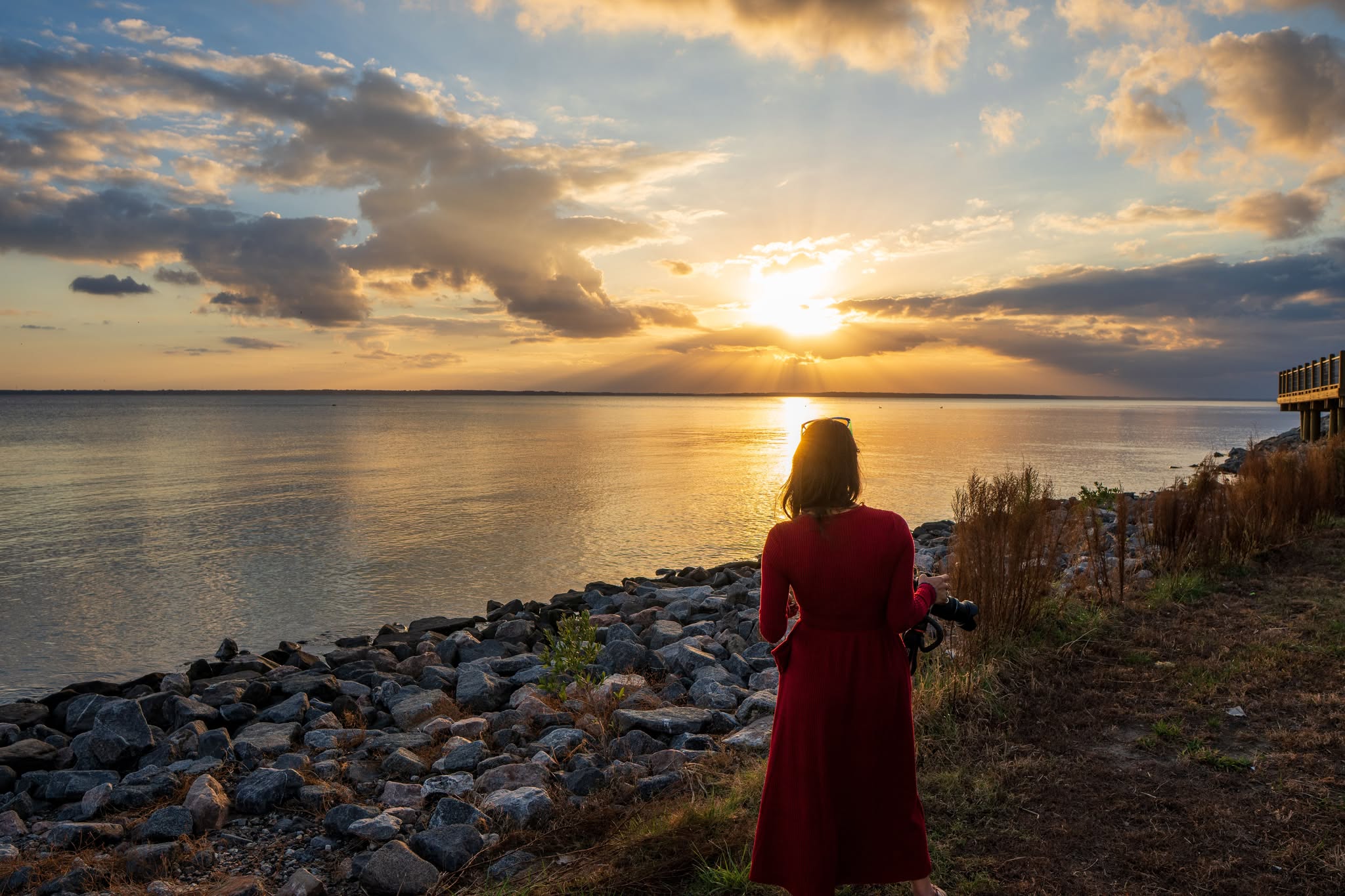
I can photograph the sun. I’ve stood at the water’s edge twice a day in every kind of weather this coast produces, and I know what that light is going to do. I can hold the sun as a firm, round ball sitting on the horizon. I can stop the aperture down and split it into fourteen points reaching out across a frame. It isn’t luck or a filter; it’s a decision I make in the moment based on what the sky is doing, and I’ve done it enough times to be consistently right.
I cannot photograph the moon.
It was full last night. I’ve tried everything: spot metering, manual, every combination I know. This morning, I managed to make it burst the way I do the sun, and I looked at the frame and deleted it because that is not what the moon is. The moonlight we see is reflected sunlight. The moon is not the source. Forcing it into a starburst is a lie about the sky, and I aim to capture just what God actually reveals.
In any event, I have a long, ugly folder of failed moon shots and a hard drive full of suns.
Showing up at Hampton Roads rivers twice a day for a few months has taught me about more than chasing the light. Every Sunday, I used to check the schedule for low tide at Fort Monroe beach so I could arrange a proper sea-glass stroll. Now, I check high and low tide times to see what I’m working with at sunset. Some places, like Riverview Farm Park and Poquoson, I prefer at low tide. Others, like Denbigh Docks and Gloucester Point, I love to shoot when the river has swallowed the boat docks.
What clicked for me this week is that the sun and the moon don’t keep the same schedule. A lunar day is about twenty-four hours and fifty minutes because the moon is moving around the Earth while the Earth rotates. The timing of the tides shifts from day to day, too, though the water has its own complicated rhythms depending on where you stand.
They do not line up. They were never going to line up.
Some evenings, high tide arrives right around sunset and the river becomes a mirror, and you get the best frames of your life. Some evenings, the water is out, the docks are stranded, and the birds have gone somewhere else. The conditions aren’t random, even when they disappoint you. The tide follows its own patterns. It just keeps a different schedule than the sun does, and no amount of standing on the shore wanting them to meet will move either one of them.
I spent three years waiting for somebody’s revolutions to line up with mine.
When they did, we were fine. When he was full, I loved to look at him. The problem was never the full moon. The problem was all the time in between, the waxing and the waning, when there simply wasn’t enough light to work with and I kept adjusting my settings anyway, certain that if I just learned the right technique, I could make the exposure work.
I could not. It was not a technique problem. I was photographing something that does not make its own light.
The moon has real power, clearly. It moves the entire ocean. It took my beach away twice this month. The thing I could never capture still rearranges the shoreline I stand on every morning. Acknowledging its power isn’t a betrayal of my clarity.
Last night at Denbigh Park, I met two missionaries on bicycles. I’d caught them reclining on the docks. They wanted the shots I’d taken and asked me to take some more. We talked about the sunsets in the area.
They had heard about Lions Bridge and wanted to see it, but it would be a two-hour ride each way, and they weren’t sure it was worth it. I pulled up Friday night’s frames on my camera display and showed them. Not the edited ones, but the RAW files, straight off the card, unpolished.
Their faces lit up. They decided the ride was worth it.
I spent last week convinced I had become irrelevant. I wrote in my journal that nobody cares about my pictures and that the whole routine is a waste of hours. Then, two kids on bikes looked at the unedited work I made on the night I was most distracted and decided to pedal four hours round trip to stand where I had stood.
It meant something to me that my art had connected people with God’s beauty.
Two Octobers ago, I published a blog post about apologies.
I wrote about how I know when somebody is really sorry. I said that words alone are not enough for me, that what lands is a person looking me in the eyes and accepting responsibility, saying out loud, “I messed up.” I wrote that genuine repentance cannot be judged on commitment alone, that it takes time and further opportunity to demonstrate change before forgiveness is real.
I meant every word of it then. I mean every word of it now. It’s the standard I am still holding.
It turns out you can still love someone after the apology that will never come.
Tomorrow, I will see my husband for the first time in months. I’ve been preparing for it so that when I see him, I will not come undone.
But first, there will be a sunrise.
I’ll get up in the dark, pull on a warm sweater dress, and drive to the water’s edge. The tide will be rising, the moon waning, and me? I’ll be looking for the true light to reach everything, especially me, with my camera ready for a date with the sky.

