There is a moment at the pier, most mornings, when the light comes up over the water and something in me wants to kneel.
No one asks me to. The sun doesn’t demand anything, doesn’t require my attention or gratitude or presence at 5:40 in the morning with a camera and a cup of coffee. It simply rises, the way it has every day since Genesis, whether I was standing there or still asleep with the blinds drawn. And yet, something in me responds to it like iron to a magnet. The heavens declare the glory of God, and the sky above proclaims His handiwork. Declare. Proclaim. The sky isn’t asking. It’s announcing; worship is just what happens in me when I’m standing close enough to hear it.
There are those who envision faith as a cage, and I cannot imagine a more opposing metaphor than what I have experienced. What I find at the water’s edge is the least controlled I have ever felt. There is no obligation, no performance. I am simply a woman beside a fishing pier, as small as she ought to be, watching the God who made all of it paint the sky for free and let her stand in it.
I do not worship because I am commanded to. I worship because my soul does it involuntarily, the way lungs take air.
Which is exactly how I ended up building an altar to a man.
I’ll share my cautionary tale here, because I believe there’s someone reading this who needs to hear another woman say it out loud first.
I worshipped my husband. I spent more time concerned with how to honor him than how to honor God. I was more interested in pleasing him than bringing glory to God. I weighed my worth on belonging to man instead of the inherency of value in being God’s child.
The easy version of this story would be that I was afraid of him and called it love, but that wasn’t what happened. At first, I worshipped him because he was beautiful, because he walked into my life and turned all the lights on, because he was handsome and funny and he read my mind, and because for a while, he was genuinely, unmistakably good to me. That’s not a delusion I have to correct in hindsight. It’s the problematic reality.
I built the altar during the good days. And when they stopped being good, I did not stop worshipping.
It’s not that I was fooled; it’s that devotion has momentum, and I kept bowing at an altar long after the idol on it had turned. Quite frankly, I had been bowing for so long that stopping felt like the sin.
He never asked me to do it. That’s the part that indicts me rather than him. There was no command, no demand, no requirement. It was the same involuntary motion I feel at dawn, the natural response of a spirit built to bow… aimed at a man who was, at the very best, a gift I had lifted onto a throne that was never his.
I don’t think that makes me stupid. I think it makes me human. We are all worshippers, every one of us, and the only question any of us gets to answer is what. Idols are almost never ugly at the start. They are usually good things loved past their weight. When the sun sets over stone, however, the idol lays cold and dull. It is not a source of light, merely illuminated by it.
He wasn’t a believer, but he loved creation. He’d look at the water the way I do. He noticed light. He talked about the Creator with a kind of reverence that made me think we were speaking the same language, that we were standing on the same shore looking at the same sun, just a few steps apart, literally and figuratively.
So, I waited.
I sat beside him in church and waited for one of Pastor Colin’s sermons to land right. I waited for the Word to catch. I imagined the moment he’d step out of the dark and into the light, and I swear, I could see it. I saw what he might have been. I think, once or twice, he glimpsed it, too.
I still believe God could do it. It costs me nothing to say and it’s true: I have prayed, and I still pray, for a transformation I may never see. That’s not the same as wanting my old life back. It’s just what you do when you have looked at someone and seen what the Light could make of them.
That said, you cannot build a temple on someone else’s maybe. I tried. It came down. Unless the Lord builds the house, those who labor do so in vain.
The aftermath of separation is unique to everyone and yet somehow universal: grief has weather, and there is no forecast.
I check a radar map every evening now to decide which shoreline to drive to. I’ve gotten good at reading the sky. What I cannot read, at all, is what any given day is going to do to me. I can wake up gold and be gray by noon. I can go weeks steady and then find myself unable to fall asleep until I write a letter to a man I am not allowed to contact, filling page after page with everything that never got said. Our marriage didn’t end with a conversation; it ended with an arrest and a no-contact order, and then dissolved silently in the days after… shared calendars, streaming accounts, a family file folder moved to an external drive. Wound after small wound, none of them witnessed.
There was no goodbye. There is no closure coming. I have had to learn that the absence of an ending is the ending, and it may be the truest thing I have ever accepted.
I wrote the letter anyway. It sits on my desktop and it will never be sent because the man it’s addressed to is not the one who can heal what it describes. My words aren’t wasted, however. When the divorce is final, I’m going to take it down to the fishing pier at first light and read it out loud to God, every word, and then I’m going to burn it there while the sun comes up over the York.
He will be the audience. He’s the only one who was ever going to be able to receive it. His light is the only remedy to heal wounds incurred in the dark.
The paradox is that I don’t want this divorce. I need this divorce.
If you are somewhere in the middle of your own version of that sentence, it’s a legitimate place to stand. Both halves are true at once. Wanting something and knowing you cannot have it are not contradictions, they’re just the two ends of the same broken bone. You are not faithless for grieving what hurt you. The heart does not surrender its attachments on the schedule the calendar sets, and healing that comes slowly is still healing.
Forgiving him did not dissolve the longing. I have learned those are two entirely different organs, and only one of them answers to a decision.
What is actually happening, I think, is a change of ownership.
I belonged to him. Legally, I still do. I took his name, and things still come in the mail addressed to a woman he now says he never wanted to exist… but underneath that paperwork something older has been reasserting itself, and it turns out I was never really his to begin with.
No one is born into a religion. I’ll grant that gladly. We come into the world with a soul and nothing else, and that soul is not yet a temple. Mine became one when the Spirit moved in, not by my birth and not by my effort and certainly not by my marriage. And a temple has an owner. I spent 891 days trying to give mine to somebody who could not have held it if he’d wanted to.
Wife to daughter. That’s the whole shift. Except I was the daughter the entire time, and I just had my back turned, watching a man in the foreground instead of the sky behind him.
I could not have weathered the unexpected storms of grief alone. Whenever I pray for God to hold me, someone shows up.
There are people from my church who check on me without being asked. A small group that has held me on the weeks I couldn’t hold myself. A community at the fishing pier that has grown, morning by morning, into something like family. A handful of friends I go deep with. And at least three mothers, one of them my own, praying over me every single day.
If you are in the middle of this, do not do it by yourself. The bond does not break by willpower and it does not break on a schedule. It loosens in the presence of people who keep showing up, and in the presence of a God who was never going to leave, and it loosens slowly.
I don’t build altars anymore. Not the way I did.
The one I made for him took years, and it came down in a single night with nothing left standing. I don’t have another one in me. I couldn’t construct something that elaborate again if I tried. I pray I never do again.
Because what I have found out on that pier, morning after morning: I don’t have to. The altar is already there. It was there before I arrived and it will be there when I’m gone, three hundred sixty-five sunrises a year, laid out over the water whether anyone comes to see it or not. I don’t build it. I just show up to witness it. No matter the state of my heart, the beauty of God’s creation fashions the corners of my lips into a smile.
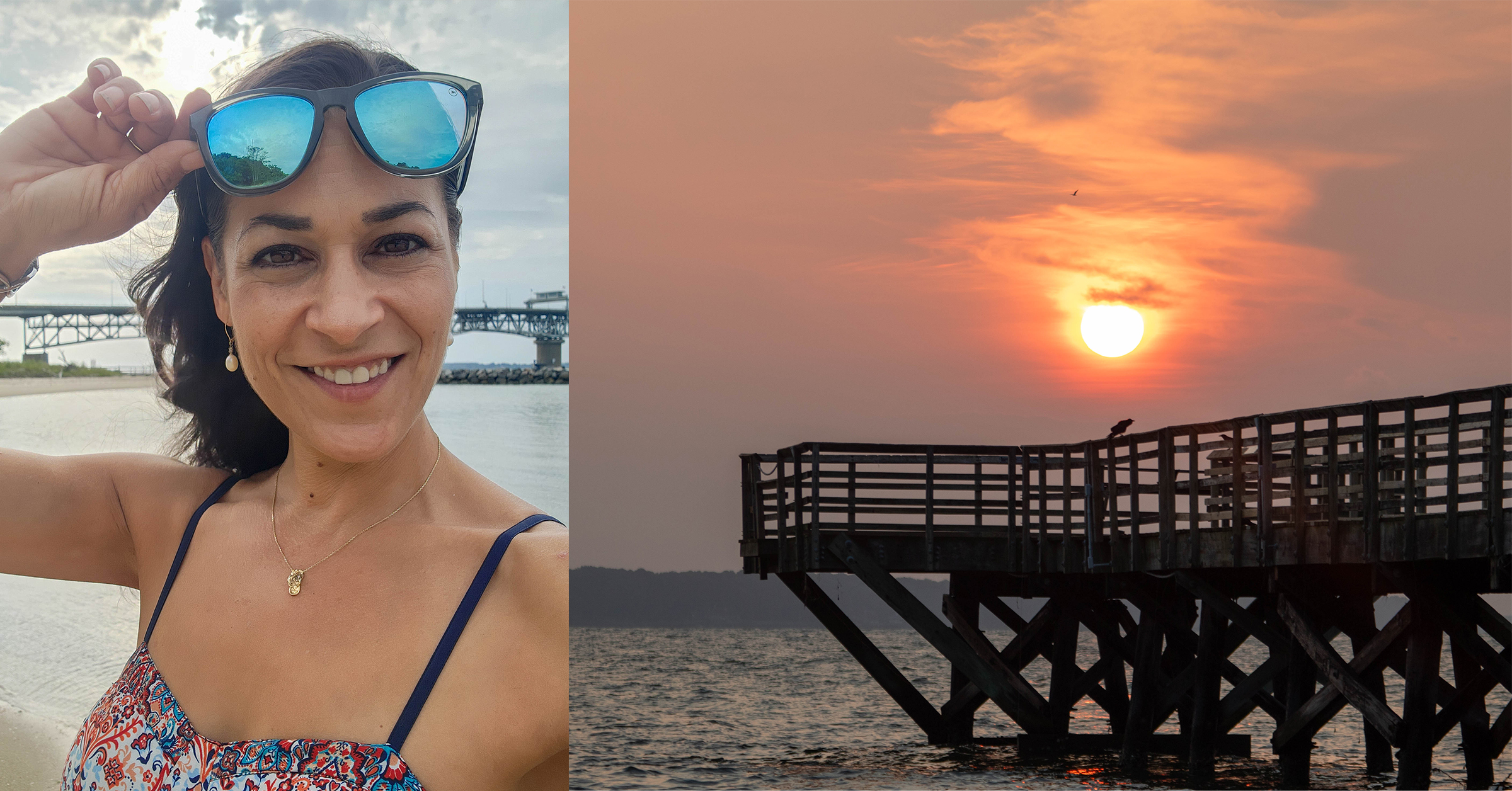
That’s all I know to do now. I get up before the light, I drive to the river, I stand in front of something I had no hand in making, and I lift a camera instead of a hammer. That’s the offering. I take pictures so that other people might look up. I keep chasing the light so I can say, look what He did, look what He does, He did it this morning and He’ll do it again tomorrow.
The first altar I built was made to hold a man, and it could not bear the weight of him.
This one holds up the sky.
 Writer's Growth