I spent this week fixing a photograph.
The cover of my second book came back from the printer too dark. I’d built it on a screen in bright RGB with all that backlit color; when it converted to CMYK for print, the light compressed. Faces fell into shadow, and the image I’d loved on the screen wasn’t the image that came out on paper.
My gut said raise the highlights. Force more brightness in, but that wasn’t it. The fix was to raise the shadows, to lift the dark places until the detail buried in them came back up. Not more light… less lost in the dark.
I have been thinking about that ever since because it is the truest thing I know right now.
Perception changes. I had at first built a cover around a photo of myself on my old front porch in Hampton, typing on a white wicker loveseat with a glass of red wine and moonflowers blooming around me. It seemed right until I held it in my hands and felt nothing. My writer’s group said it gently: it didn’t look hopeful. They loved the loveseat. They kept the loveseat. Still, the picture I’d dreamed wasn’t the picture that printed.
Perception changes. I used to be a sunset girl, back when I believed I had all my life ahead of me, all the time in the world. Now I rise before dawn and drive to the water to meet the sunrise because I don’t want to waste the light. Same sky, but there’s a different woman looking at it.
Perception changes. I moved into a bachelor’s house and turned it into a home, everything labeled and ordered, our games and our puzzles and our beach gear merged into one life. The irony is that the order made it easy, years later, to pack the boxes. That said, dividing the belongings doesn’t divide the memories. You cannot label them, separate them, or pack them. Four months on my own, and I can settle into a space that looks, feels, and smells like me.
Perception changes. There was a sticky note on my monitor at school, a little hand-drawn heart, and on the back it said he was here with me. I took it down. A student grabbed it out of my hands, balled it up, and threw it toward the trash. It missed. After class, I unfolded it, smoothed it flat, and grieved the man I thought was always going to be here. Grief and gratitude can coexist in the same square inch of paper. That, too, is a thing the dark holds that the bright dream couldn’t.
Perception changes. I put off becoming a member at my church for the longest time. I told myself it was complicated, that one day the question of baptism would become a wall between my husband and me, and I didn’t want to be the one who built it. So I kept showing up on Sundays, sitting beside him, belonging to no one. Then he was gone, the wall I’d been protecting wasn’t there anymore, and I realized nothing had ever actually been holding me back but the shape of a life I was trying to keep. I bit the bullet. I joined a small group. I officially became a member last week. Now I have an elder, a greeter, a pastor, and a circle of women who care for my soul in the season I need it most. They were there the whole time I was married and simply dating the church. God filled the absence beside me with people who can love me without conditions.
Last night I was raw. I’d been crying. I drove to the pier at sunset with puffy eyes and kept my sunglasses on so no stranger would see. I sat with my toes in the sand and scanned the last chapter of my proof copy, when it struck me that Two-Hour Tuesdays comes out in a week and I’d hardly given it a moment. I’d been busy surviving.
A retired deputy backed his car in beside mine and set up chairs in the parking lot. I had to close my car door so his passengers could get out. I helped an elderly woman out of the back seat and settled her into one of the chairs. She is losing her sight. She told me she can still see contrast now, lights and darks, the bones of an image. She had come anyway, eyes failing, to sit in front of a sunset she could mostly only feel.
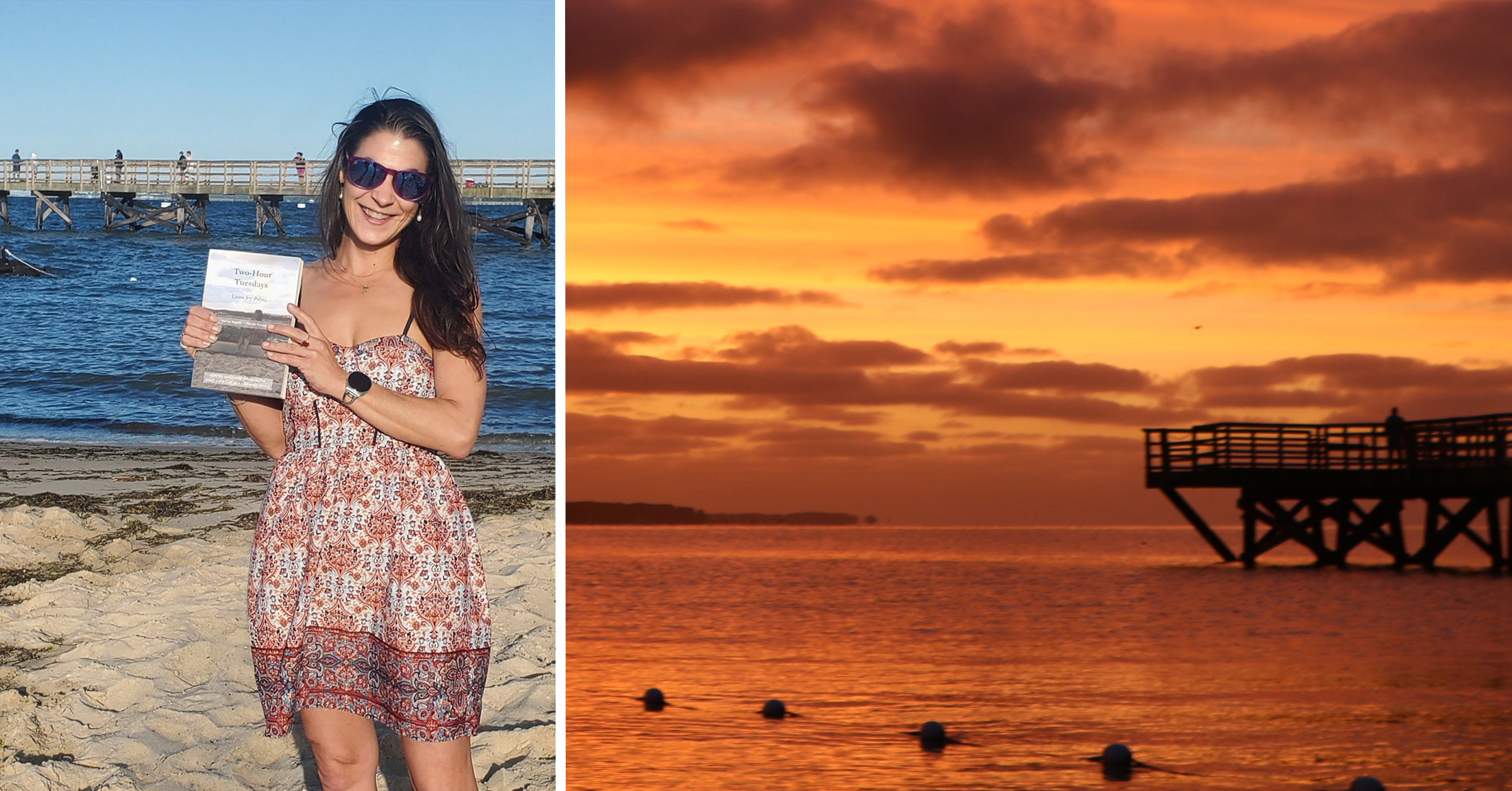
I showed her sunrise photos on my phone with the same view before us then, the ones with the deepest contrast, and she giggled with delight. She could make out the pier. She could find the sun cresting over the water. I showed her my book covers, the sunrise, then the sunset; she held my proof copy in her hands and asked if she could keep it.
I told her that book doesn’t exist yet, not until next week. She looked disappointed. So, I went to my car and came back with a signed copy of my Fearfully, Wonderfully, and Bipolar-ly Made: From Shame to Sanctuary, the one that does exist, and I put it in her hands. Her friend will read it to her. “You’re a real author,” she said. “And you signed my book. I can’t believe this happened to me.”
I had driven to that shore in despair. I left it a light to someone else.
She could only see contrast. Lights and darks. Perhaps, that’s the secret of the picture. You can’t raise the shadows without the light to measure them against. Nor can you find the buried detail without the dark to bring it up from. The brightest version of my life, the one I dreamed in RGB, was never going to print. The real one? The one with the shadows lifted just enough? It has detail in it the dream never did.
A blind woman at sunset with a signed book in her hands. A church full of people holding her up. A house that’s more home to me now than four months ago.
The God I trust has always worked this way, though. He didn’t begin with light. He began in the dark, hovered over it, and called the light out of it.
Perception changes. I used to think the solution was more light.
It was never more light. It was less light lost in the dark.

