We read Robert Frost today. I’ve taught this poem every year I’ve stood in front of a classroom — eight lines, a small forest of figurative language, a perfect SOL review hidden inside something true. The kids draw their gold. “What’s precious to you,” I ask, “that won’t last forever?”
A girl drew her dog. Another drew her grandmother. One boy drew a jersey with #17 on it, and I knew him well enough to know he meant our Buffalo Bills quarterback. Another drew the screen of a video game and the child next to him copied it. A small head bent over a piece of paper, choosing, in a way she didn’t quite know she was choosing, what to grieve in advance.
Tears pricked my eyes as I walked between the desks.
I have been traveling through time this week.
Promoting my book has been reaching backward… across decades, across states, across the years I left behind in Syracuse and Nashville and Chicago. Friends I haven’t spoken with since college finding me again because of a cover and a title and a few hundred pages between them and us. People I loved when I was someone else, reaching back.
I’m editing my second book in a different season. Two-Hour Tuesdays is about a different chapter, a different relationship, a different version of me. Right now I’m working through 2016: the year of the white wicker love seat on a front porch. That girl was searching, discovering, sharing, growing. She was precious. Reading her words is like watching footage of someone I used to know.
I am editing her in a gazebo in my current backyard. There are no half-finished projects back here anymore to distract. I moved the last few remaining pallets myself this weekend, dragged them beside the back garage because I didn’t want to look at them. The gazebo is new. There’s a writing table inside. It is, in many ways, the perfect writer’s abode.
It is also quiet in a way that has nothing left to interrupt it.
Nature’s first green is gold, / Her hardest hue to hold.
What was gold to us was real. The front porch with the wicker. The girl with the dog she drew today. The boy with the number 17. The seasons I have already lived through. None of it stays, and that isn’t a tragedy. It’s the nature of gold.
The tragedy would be forgetting it was gold in the first place.
I spent the weekend trying to escape a day I’d given more meaning to than it deserved. I could not. I tried to fill the space with people. It didn’t work. The grief was still beneath everything.
Mary Beth and I walked at Fort Monroe on Saturday. Down at the jetties, a small flock of children was climbing about the rocks. “We’re searching for treasure,” one of them called out, holding up a shell, a bit of sea glass, and a piece of plastic. They were unsupervised like we used to be as kids in a different era. They were simply playing. Safe and at play at the seashore.
I cannot imagine, anymore, being able to play.
That’s not a complaint; it’s an awareness. There was a child on those rocks who was me, once. I had a good childhood with imagination and nature and joy and no need for hypervigilance. That childhood was gold. The fact I can no longer access whatever permission those children have to play does not unmake what I once had. It just means there are seasons of gold and seasons of after. I’m in an after.
So Eden sank to grief.
Frost knows. He gives us the whole arc in eight lines. The first green is gold; the gold doesn’t keep; leaves subside to leaves; Eden sinks. We end where and when we end. Nothing gold can stay.
I teach this poem because it still teaches me something new every time. What did I see this time I missed the first dozen or so analyses? Frost doesn’t say the gold wasn’t real or that it should not have been treasured. He just says it cannot stay.
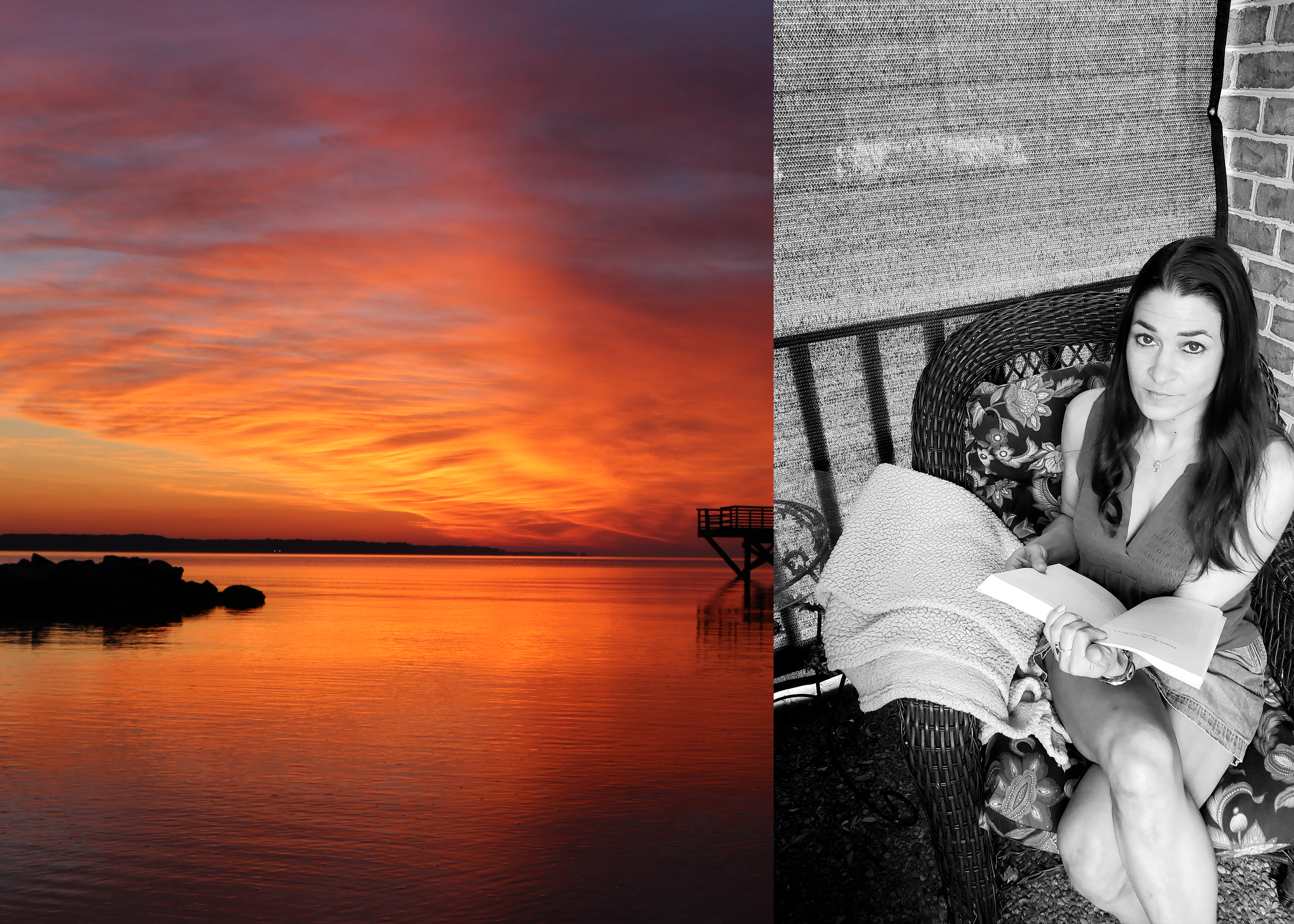
I have been smiling in every photograph attached to this book launch. I should be. I worked for years to put it in the world. I am proud of what it is and grateful for everyone who reached back when I reached out. However, I have not been smiling much, otherwise. The contrast between the two of me, the one in the press photos and the one sitting on my front porch right now, is so loud it could be its own poem.
I wrote a blog post in 2021 about my grandfather’s garden, and I ended it with a journal entry I’d written at fourteen. I offer my life. All that I am, all that I have, I lay them down before you, O Lord, all my regrets, all my acclaims, the joy, and the pain, I’m making them yours. I was praying those words in silence in 2021, and I’m praying them again five years later.
I know who was with me when I wrote the first book in my Yorktown backyard. I know who was with me on the front porch in 2016. I know who is with me in the gazebo in my backyard and my cozy corner on the front porch. The seasons of gold come and go. The companion in each one does not. God was my companion when they were gone. He is my companion now.
This morning, before any of the rest of it — before the press kit emails went out, before the classroom and the drawings and the tears, before the meeting I didn’t want to walk into — I went to the pier. The sky turned the water gold, and I stood there in the stillness watching the world remind me that gold begins each day without any action on my part.
The gold was real.
The gold doesn’t stay.
The One who made the gold remains.

