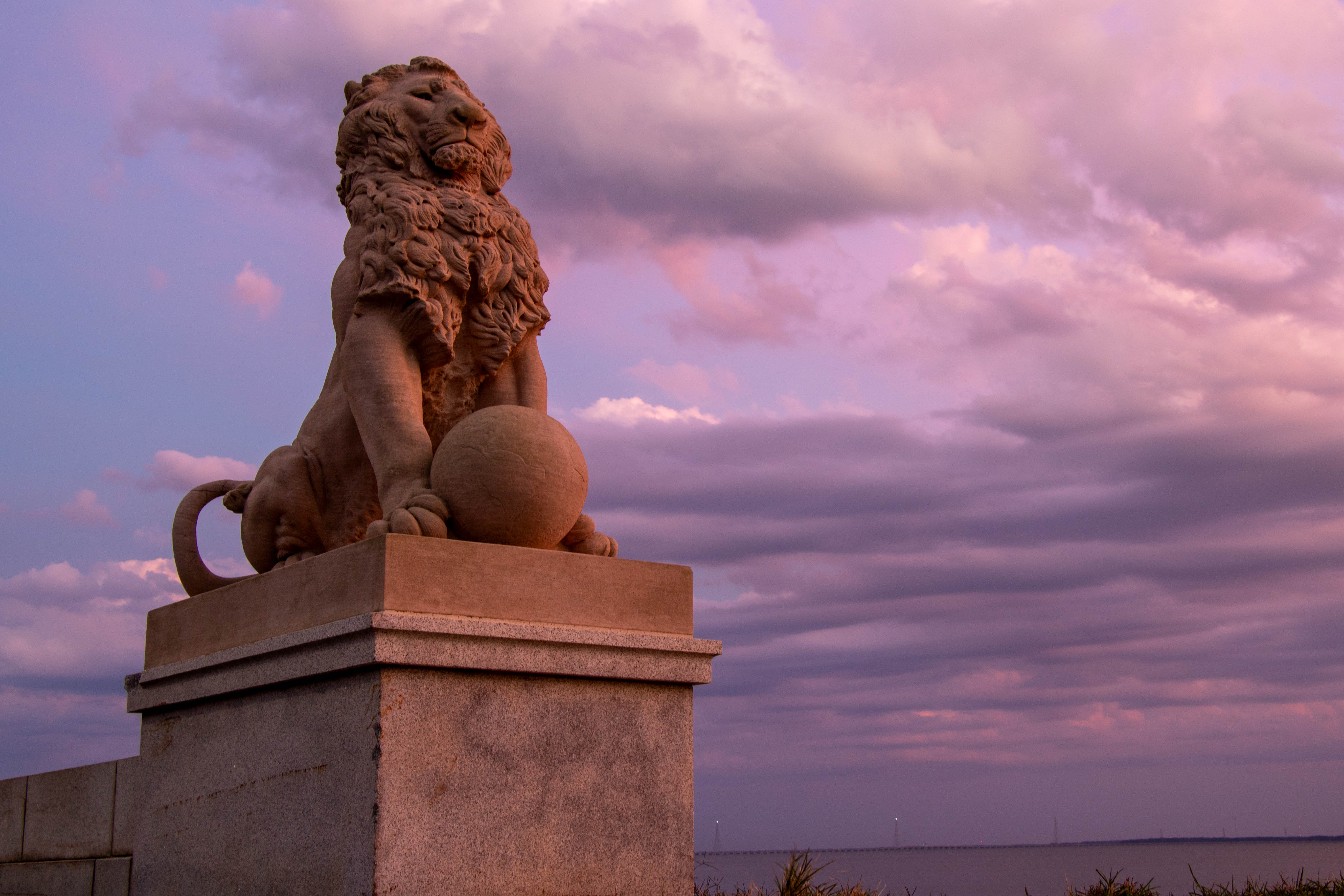
There are four stone lions at the end of Lions Bridge. They’ve called me back for months now.
They do not move. I do. They do not change. The sky does. I spent all summer working one lion in particular, realizing quickly he was never the same lion twice.
Some nights he is roaring. I align the sun in the gap between his legs and let it burn there or pop a starburst; he comes up fierce and hot and awake, and those are the frames people love. Other nights he is at rest. On Thursday, the sun was playing peek-a-boo behind a giant deck over the James, and I got that starburst, only it didn’t capture what I felt. I turned around and shot him against the southern sky instead, which was lavender and layered with storm cloud, stunning and nearly pulsing, and in that frame, the lion seems finished and at peace.
Same stone. Same animal. Nothing changed but what was behind him, and of course, where I was standing.
And isn’t this what we do with God?
We hold up one frame. The roaring one. Judgment and wrath and justice, blown out, unrecoverable highlights. You cannot bring the data back in editing. It is gone. What remains is a fragment, and people often assess God from a fragment of a blown out frame that had genuinely encountered something beautiful, big picture lost for the sunburst.
The God I meet at the water’s edge twice a day is so much more than Judge. He is radiant and remarkable and awe-inspiring and ridiculous with generosity; He is all of that on a Tuesday even if no one else is watching. I have a hundred frames of a stone lion and not one alone tells the full story of him either.
When I write, I grow. Two hours on Tuesdays, and now after sunrise and sunset in small bursts. When I shoot, I grow, too, more than two hours every day, and it’s teaching me as much as writing about life has.
What I see on the display is not what is stored in the file. The little screen on the back shows me an approximation; it’s a preview the camera generates, already processed, already lying a little. The actual data lives in the RAW file, and the only honest way to know what I caught is the histogram, which shows me the light itself as a graph rather than a picture.
One of my photography mentors, Jerry Gammon, shoots mirrorless. What he sees is essentially what he gets. It’s tempting, and maybe something for down the road.
However, not having it has forced me to learn the craft instead of trusting my eyes. I have had to study how light records, learn to diagram a histogram the way I do sentences, to understand a scene can look dark on the screen and be perfectly exposed in the file, or look right and be ruined. Somebody told me recently to stop leaning on the LCD to judge exposure, and they were right, so I have been working on it ever since.
Four months of shooting fully manual. Two or three hours of practice every day, in whatever the sky is doing, I’m no longer simply chasing that moment the light crests or disappears. I’m looking at what the light does to everything around it.
Saturday night in Poquoson, I had trouble believing what I just wrote. I’d spent all day working in the yard enjoying the moody clouds. By the time I got in the car, everything ached. There was no light, either, just bright, overcast grey. I went to Floyd’s Bay and experimented with an ND filter for long exposures, creating a mirror for the trees in the still bay.
I pair this location with Hunt’s Neck Point, simply to give me variety, and I shifted there at a quarter past six, hoping beauty might show there. A heron flew over and would not land. Nothing happened. I stood in the marsh looking at the back of my camera and later wrote it was my worst set ever. The bright spot was meeting a neighbor who’d lived there generation, who’d family had farmed peach trees. Could I do her shore justice?
It was not my worst set. The frames I thought were underexposed were fine since the data was saved in the RAW file all along. I was reading a screen that couldn’t tell me the truth at the end of a day when I had nothing left to read it with.
And the night before, News 3 had aired my thirtieth photograph.
I did not see it until Saturday, so for me, God stunned me and stole the sun within a span of hours. The region watched the thirtieth of my photos over dinner, and twenty-four hours later, I stood in a marsh and all but called myself a fraud for playing around with black and white photography while clearly an amateur. My display lied to me, and I had believed it.
The one they aired, by the way, was the lion. They passed over the clever ones with the sun burning in the gap and took the lion against a fiery sky. That wasn’t my favorite of the night, either. My favorite was the lavender sky one shot against the sky without the sun, the one Jerry complimented saying, “Good perspective.” I’ve learned that when I take the sun away on purpose, we let something else become the subject and tell another story.
I have been trying to photograph the Coleman Bridge correctly for weeks.
It’s strung with lights each morning beside me, and I have been getting up early to work long exposures on it, trying to turn each of the lights into clean starbursts without underexposing the sky behind them, trying to keep the pier sharp without pushing my ISO up into grain. I emailed Jerry for feedback. He showed me how he would develop it differently.
That choice is the part I love most now. I can decide whether the sun is a glowing orb or a starburst reaching out and touching fourteen things. It is not an accident or a filter. It is an aperture decision I make in the moment based on what is happening in the sky, and getting it wrong means telling the truth badly.
In essence, I will not put color in a sky that was not there. I have stood beside photographers shooting the same sunset and seen their posted frames come back in colors nobody witnessed. I use Lightroom as a scaffold to recover what the sensor recorded, and the best sets need little of it. I lose confidence in a photographer who thinks he needs to improve on what God did.
Phone cameras take gorgeous pictures now. Most of the time they are gorgeous because God did something gorgeous, not because anybody chose an F-stop or framed the composition by the rule of thirds. What makes me love a photo is not what camera captures the shot or how incredible the aftertouches were in Photoshop, it’s that the person taking it hands me what God made that night. The best photographers probably knew this long before the lions taught me: Our subjects do not change. The sky does. And we do. Find the perspective that brings people that moment.
Sunday morning Pastor Colin preached out of John 15, and what I heard was not what he said.
He was talking about the world and the Christian and about bearing witness. What I heard was a sentence aimed straight at me: Long for Me, and live for Me.
I have the longing down. I go to the water twice a day because I am looking for Him and I keep finding Him there, and this blog has been one long record of that for two years now.
The living for Him is the histogram. It is the F-stop and shutter speed and twenty mornings on the same bridge. It is doing the work carefully enough that when I hand somebody a photograph, I am handing them evidence. I’m not making pretty pictures out here. I’m giving testimony that the God who made all this is radiant and magnificent and remarkable, every day of the week, including the overcast ones. Especially the overcast ones, where He takes the sun away and shows me something else entirely.
I used to think my testimony was my words. It was, for a long time. I wrote a whole book about laying something down at His feet that I had been running from for most of my life. These days, I think the Holy Spirit can bear witness through a photograph as surely as through a paragraph.
Last night, I drove back to Poquoson wanting scattered clouds and haze over the river.
The forecast said clear, which I do not love because clear skies make you work for everything. I studied my own old frames from Watkins Dock before I left, trying to find a perspective I had not taken yet, planning what to do in full light before the sun ever reached the horizon. I enjoyed the bright shoot unexpectedly, spotted scattered clouds, and headed to my second spot, Amory’s Wharf, with a little more gusto. I eased off the road toward the row of pines before the point, and there was already a car parked there.
It was Jerry.
I have been studying this man’s photographs for months. I met him once in passing at Riverview Farm Park with other people around. Last night was the first time I actually got to listen to him.
We shot the rest of that sunset shoulder to shoulder and he fed me tips along the way. And the sky did exactly what I had asked for. Those scattered clouds on the western horizon did not blush pink. They flushed red. The whole marsh caught fire and then did it again upside down in the water, and a two-day-old crescent moon hung low where the sun had set, so thin and so oddly placed that I went home and looked it up to make sure I had not imagined it.
A heron squawked somewhere out in the marsh and I did not move. I was not leaving that company or that glow to go chase a bird.
Back River gave us a full half hour after the sun was gone. We stood there and talked, and I found out that what Jerry wants more than anything, after all the years and all the craft, is to bear witness to God. I told him I did not start this for the photographs. I started chasing the sun because I was looking for a sanctuary in a storm, and the woman I was before I wrote that manuscript would not have survived last February. I was already somebody else by the time it happened.
He told me he wants me to be better than he is someday. I believe him, and I want to tell you how rare that is. I meet photographers at the water’s edge who look at me and see competition. This man gives feedback like a teacher because he is one. I see it in him because I am one.
I got home and turned on the news, and there was Jerry’s lion.
The same lion. The one he had complimented me on a few nights before, shot from a slightly different angle, with a similar storm-heavy pastel sky behind him, and he had done it better than I did. My mentor complimented my frame and then quietly showed me what it could have been. I took a screenshot and sent it to him because he doesn’t sit around watching for which of our photos get aired like I do.
Somewhere people were eating dinner with that lion on the screen in front of them. Same lion, but not the same.
I have three favorite frames from Back River last night. The sun still on the water with a starburst on it, safe and stunning and still somewhat predictable. The marsh flushed red with the grasses and a single piling in the foreground, a hazy mirror. And the last one, cooler, a tree holding the frame while the glow refused to quit at the horizon.
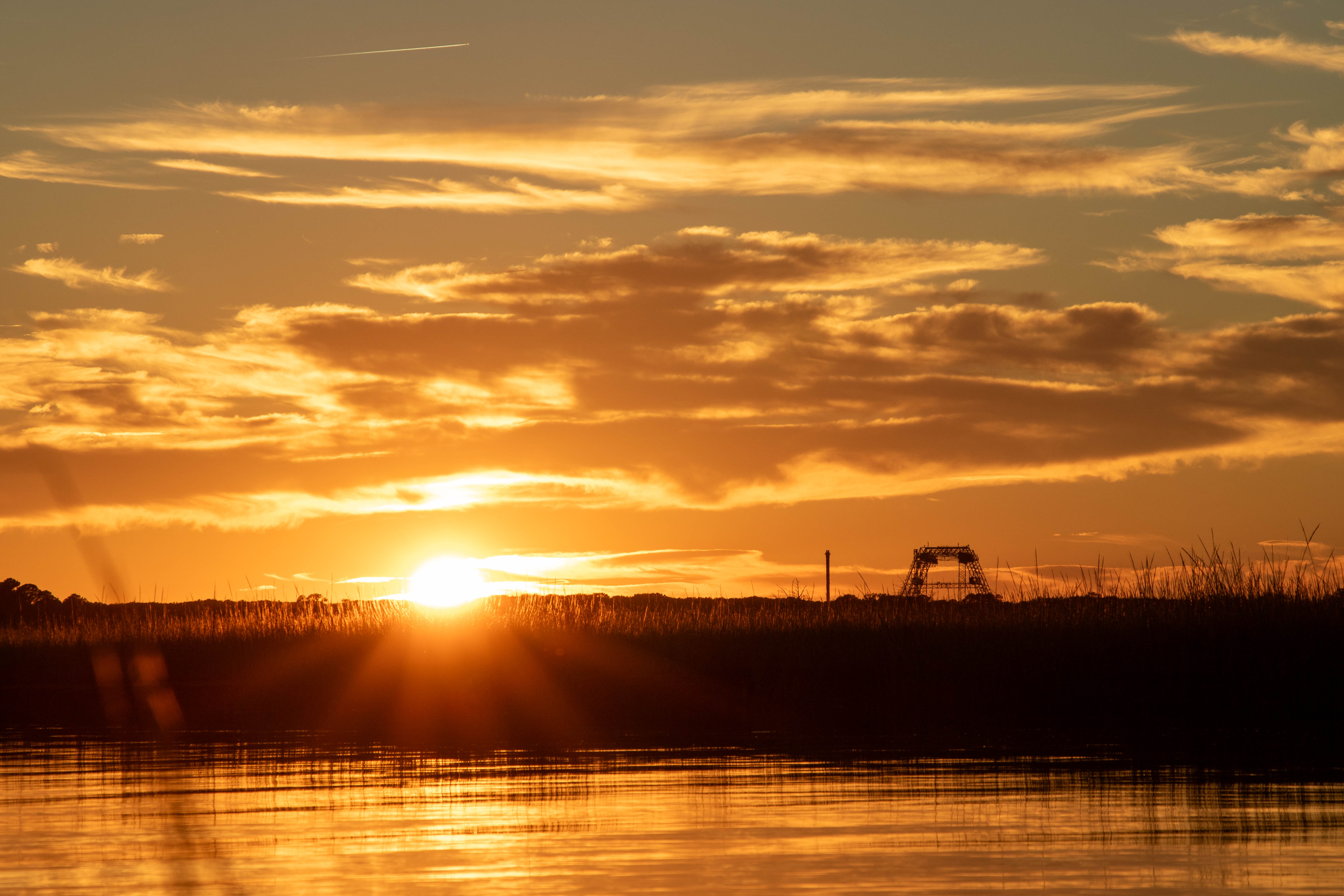
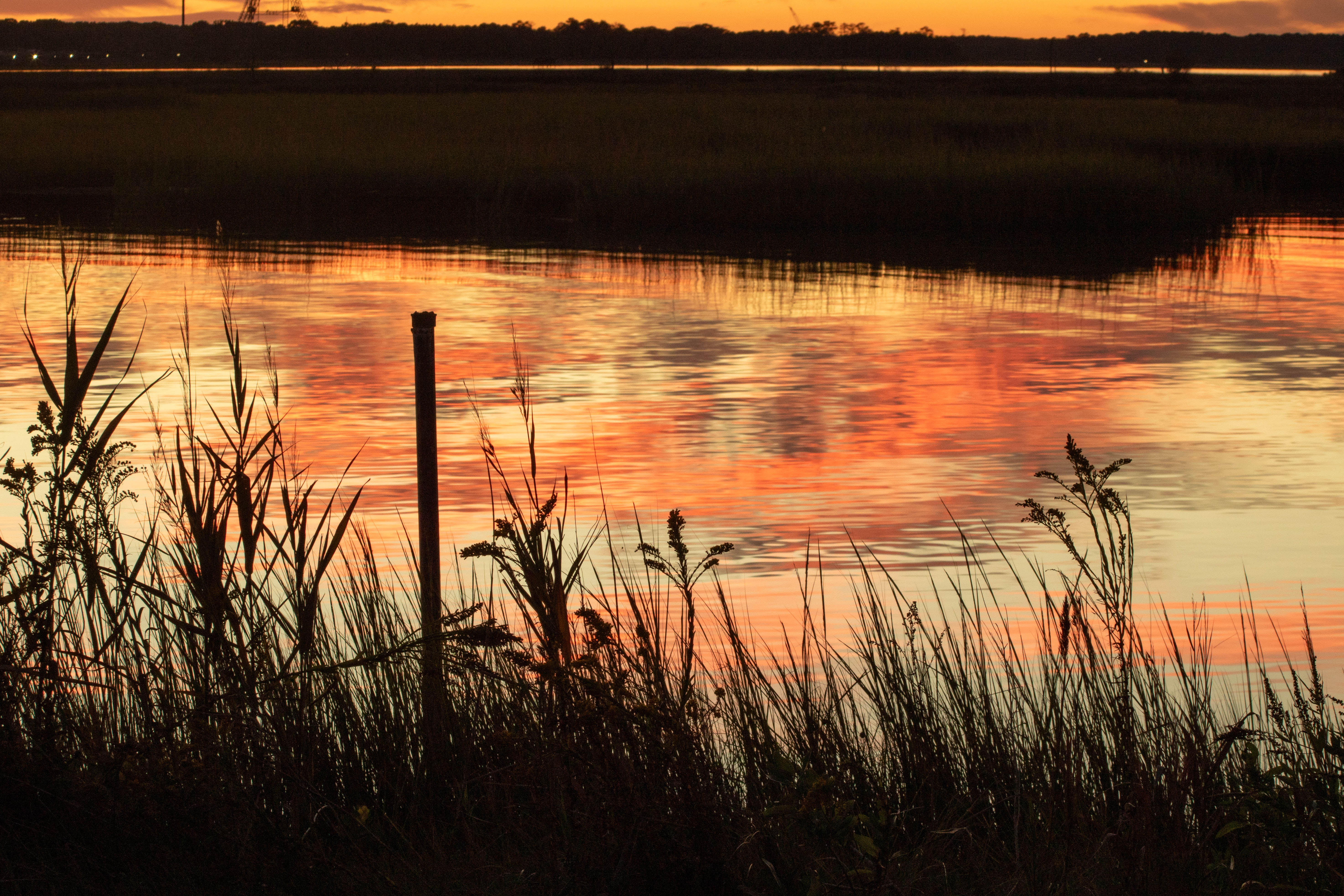
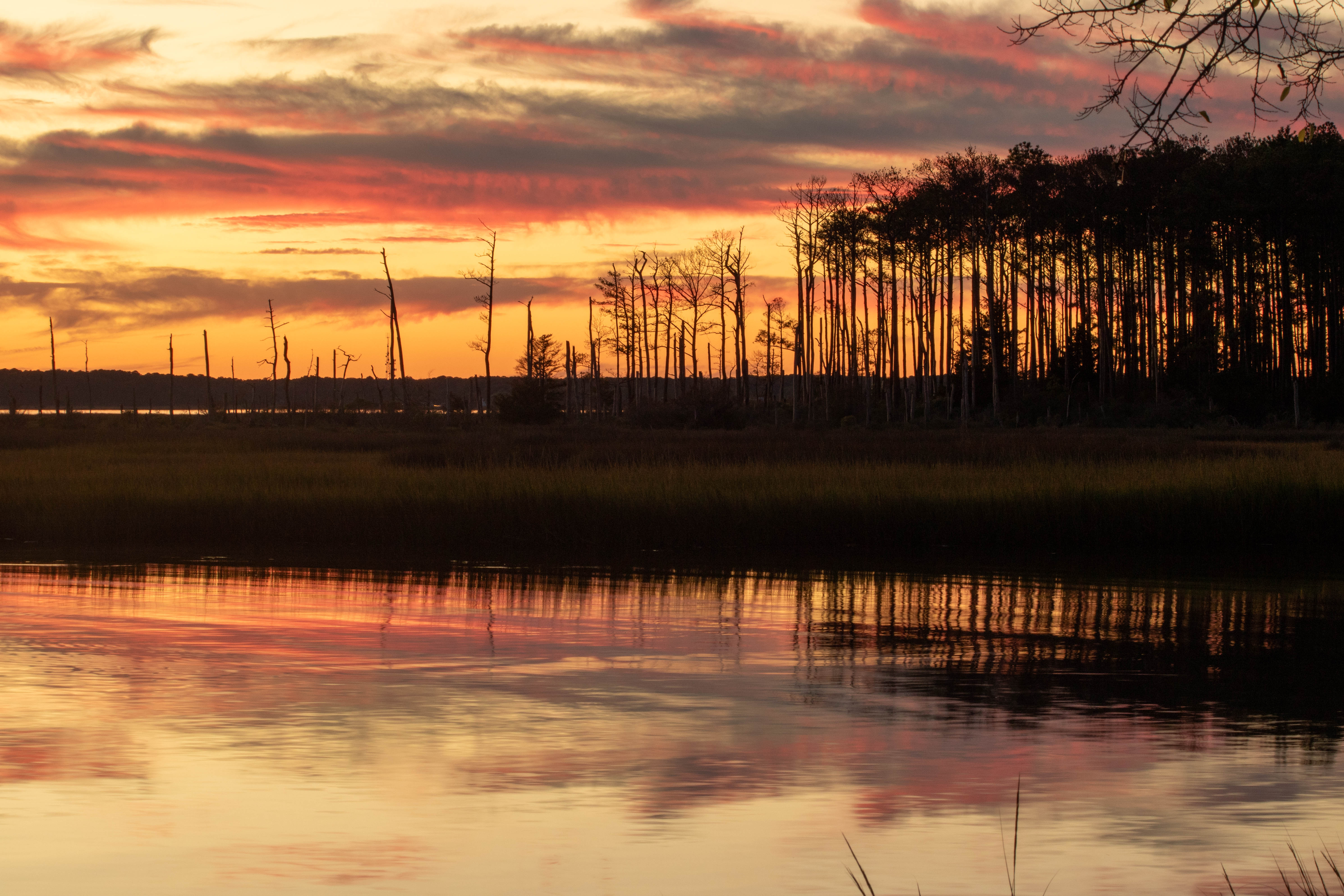
What you will not see in any of them is the shore.
You will not see the two cars parked by the pines or the man standing a few feet to my left adjusting his tripod or the thirty minutes of conversation about God and light that happened after the sun was already gone and neither of us could leave. The camera got the river. I get the memory of what happened behind it.
I can hand you evidence of what He did out there. I cannot hand you what He was doing on the bank. The lion is lying down tonight. Somewhere behind him, the sky is doing something nobody has seen before. I do not know where I will chase the light tonight, but I hope whatever I capture bears witness to the God I believe in.

