I woke up this morning a Palma.
Not divorced, but I knew I was going to need my maiden name back to survive what’s coming. So, I started the filing process on what would have been Joshua’s forty-seventh birthday, and a judge finally signed the order. Today, on the fifty-fourth anniversary of my grandmother’s death and the third of Josh’s, I walked to the water at sunrise carrying a name that is mine again.
La Palma. In Italian, the palm tree. My father’s name.
And Joy—my second name, the one my grandmother Theresa spoke over my mother in a Queens’ hospital after three days of labor and a doctor who told my grandfather he could only save one of them. “Both,” he said. God spared them both, and Theresa took that baby in her arms and called her Joy. A generation later, I’m still carrying it.
I smiled today. I surprised myself by smiling. Other teachers noticed in the hallway. “I’ve missed that smile,” one said. Kevin, who meets me at the pier most mornings and has watched me show up to that water through every kind of weather, texted me at lunch: “It’s good to see you smile again.” Billy was back, raking the beach with his tractor making noise, smoothing out what the tide roughed up, reminding me that spring always follows winter.
St. Patrick is said to have died on March 17th over 1500 years ago. I wrote that line three years ago when I sat at my writer’s perch and honored the deaths that have marked this date in my life. My grandmother Theresa, who died after complications from a routine surgery in 1972. My friend and former beau Joshua, who died in his sleep from a heart attack in 2023. My first marriage, which ended on this date in 2013. I’ve never believed in luck, but for me, St. Patrick’s Day has always been a day that marks loss.
This year, it offered something else. A return. Not luck, but a blessing.
What’s unique about palm trees is they’re designed for hurricanes. Not in spite of the wind, but because of how they’re made. Their trunks bend, and their root systems are shallow but wide, spreading out in every direction instead of driving deep into a single place. They lose fronds—sometimes all of them—and they look stripped and beaten when the storm passes. Still, the core holds, the crown grows back, and the tree is still standing.
I come from women like that.
Grandma Theresa was a Stigliano from a farm in Sharpsville, Pennsylvania. She quit school in the eighth grade to help her mother, whose arthritis was so severe she couldn’t work the farm anymore. Theresa milked cows, drove tractors, hauled a sledgehammer half a mile uphill to move the cattle pegs. Once, after the war, a man she knew from school came through the woods while she was alone in the field. He started to get fresh. Theresa grabbed that sledgehammer and told him to get out. He ran.
She wanted to be a nurse, but she never got the chance. She married my grandfather, a pastor and a printer whose temper she bore with a grace that still echoes in our family. My mother told me once that Theresa used to say, “Never reduce yourself to another person’s standard when they are acting out. Be above that.” Somehow, this farmer’s daughter who never finished school had developed a poise and dignity in the face of assault that allowed her strength under fire.
At Theresa’s funeral, my grandfather told the congregation she had been the real pastor of the church. He was right. People didn’t call for Rev. Rubbo when they needed help. They called for her. She drove the car, picked up the old ladies, visited the hospitals, counseled on the phone for hours. She never wanted a title. You could always find her in the kitchen. She sang in a choir on an Italian radio program called La Voce Della Speranza, The Voice of Hope.
My mother said something about her that I first typed twenty-five years ago in a high school research paper for a college credit course that I’ve never forgotten: “Her faith was everything—like a thread in and out of everything she was.”
Thread. That’s what I keep thinking about. Faith isn’t a chapter you add at the end; it’s the thread that holds the whole garment together. Pull it, and everything unravels. Follow it, though, really follow it, and it leads you back to who you were before the world told you to be someone else.
In church on Sunday, we sang a song with the line, “It’s your breath in our lungs, so we pour out your praise.” I mouthed the words and lifted my hands and began to weep. Not from grief this time, but because I was aware—more aware than I have ever been—that breath is not guaranteed. Every inhale is borrowed. Praise is what you do when you realize how close you came to not having it.
Then, the next song meant something it never had before: “Hallelujah, all I have is Christ. Hallelujah, Jesus is my life.” I felt it resound in a way that made me feel strong instead of weak. The last few years, I leaned on someone else for everything. I needed him to drive when it snowed. I needed to hold his hand when we walked just to keep steady. I needed him for life to feel like a good life.
Now? I drive in snow just fine. I walk the beach at Fort Monroe with Tito and collect sea glass with both hands free. Without him, a good life is finally possible.
Not because I’m strong on my own, but because I was never supposed to be rooted in a person. I was supposed to be rooted in God. And the hurricane just proved it.
Do you know what sea glass is? I’ve shared before, and I’m always willing to share again. It starts as something broken like a bottle, a jar, something shattered and thrown away. The water takes it and tumbles it for years, sanding down every sharp edge until what’s left is smooth and translucent and worth picking up. People search beaches for it on purpose. They hold it up to the light.
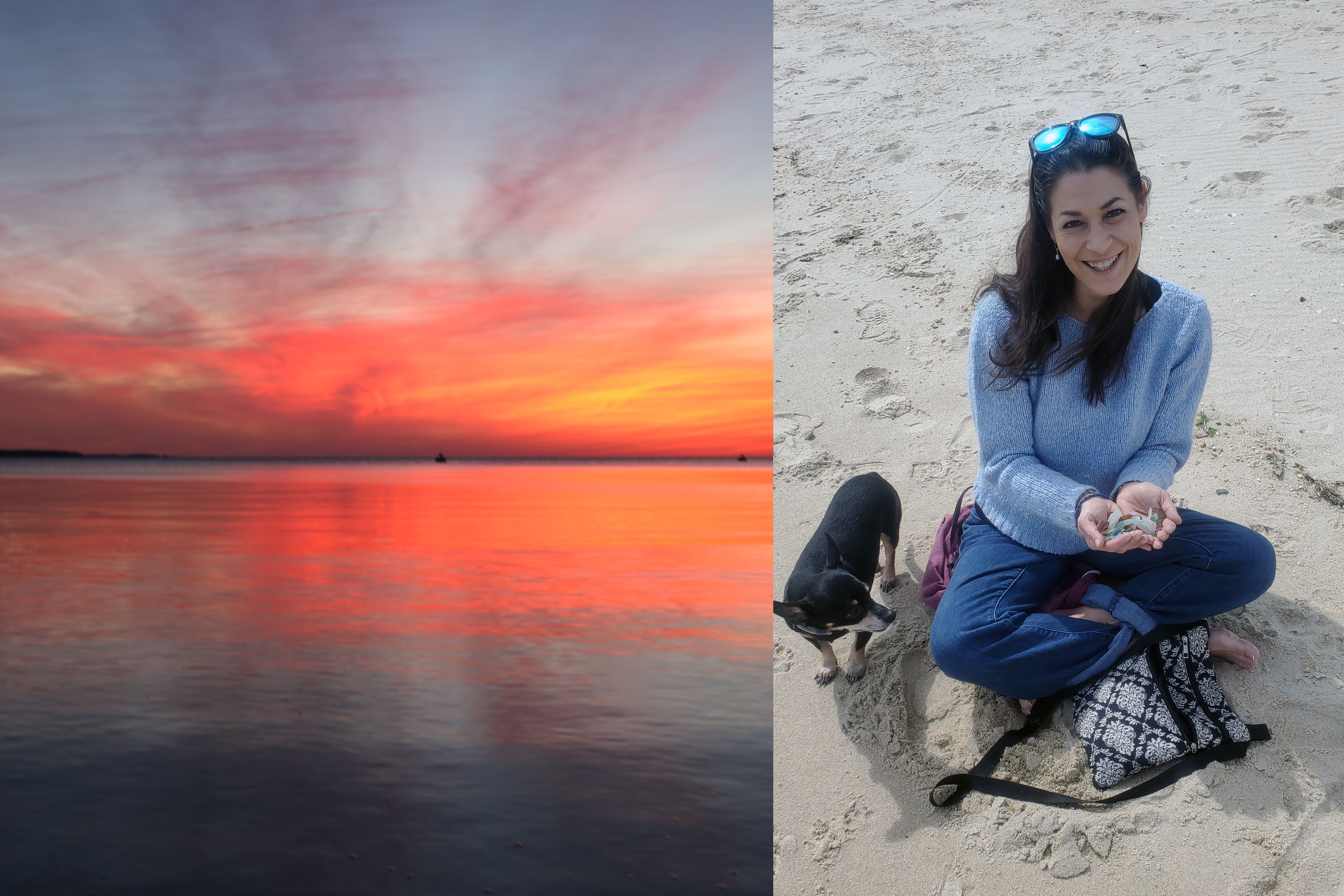
I sat cross-legged on the sand this weekend with a handful of it, Tito pressed against my leg, and I thought about what the water does to broken things when you give it enough time. Our old friend Don from the last summer I was a Palma photographed me surveying my collection. For the third time in a row, I found a piece of cornflower blue glass like the pitchers in my mother’s kitchen.
Three deaths on St. Patrick’s Day. A grandmother I never met who gave my mother the name Joy. A man I loved who died in his sleep and whose scripture—Joshua 1:9, be strong and courageous—I’m still living out. A marriage I drove away from at thirty.
And today, not a death but a naming. A return. The Father gives and takes away. Today, He gave.
The palm tree loses its fronds in the hurricane. It looks like destruction, but God designed the tree to do this on purpose. It lets go of what the wind can take so the wind can’t take what matters. The crown grows back. The roots hold.
My name is Laura Joy Palma. I belong to the women who came before me, and I belong to God, and I belong to the water I worship at every morning before the sun breaks the horizon.
I don’t belong to anyone else. Not anymore.
I was made to bend, not break, in the hurricane.
 Writer's Growth