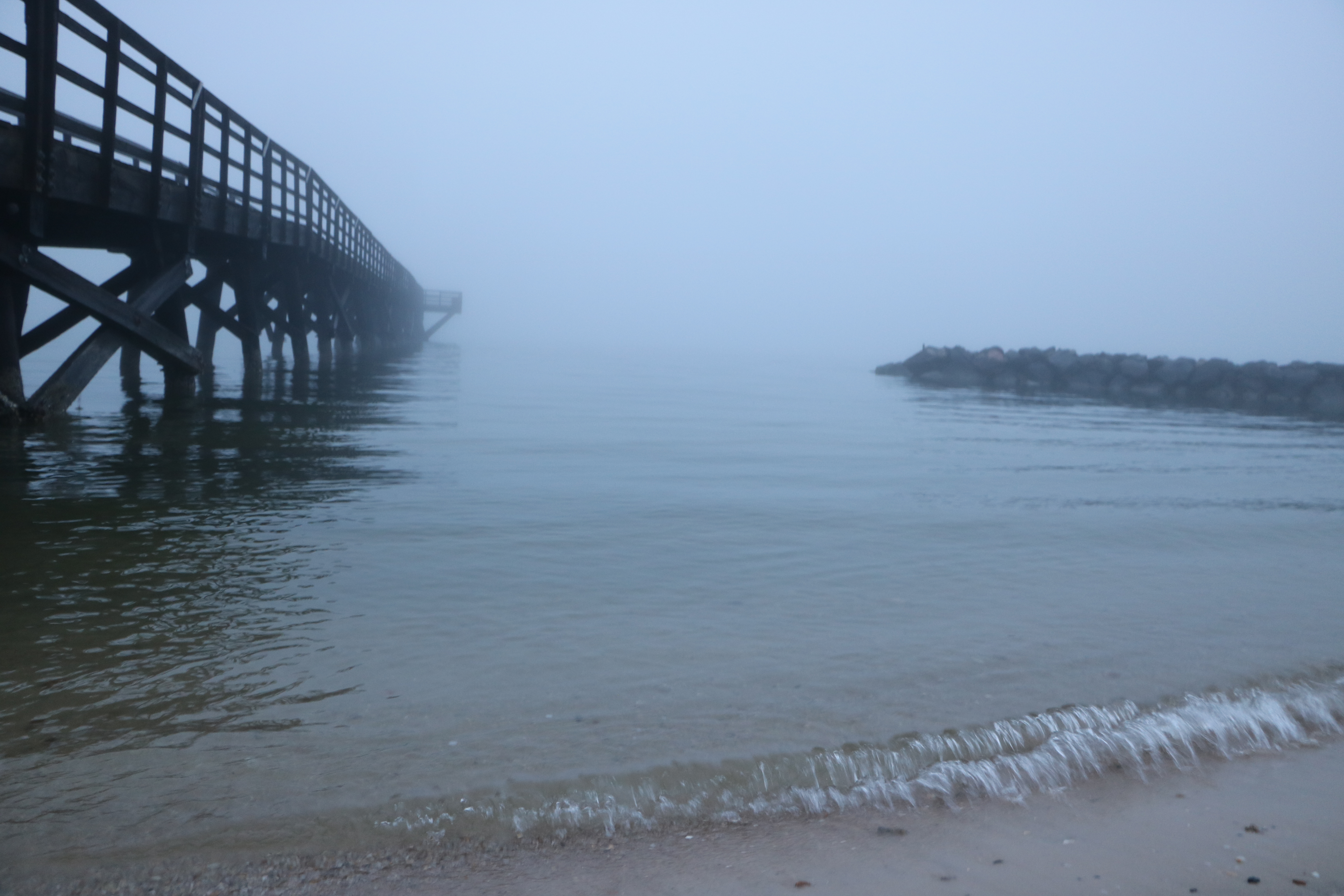
The fog was so thick last week that the pier disappeared.
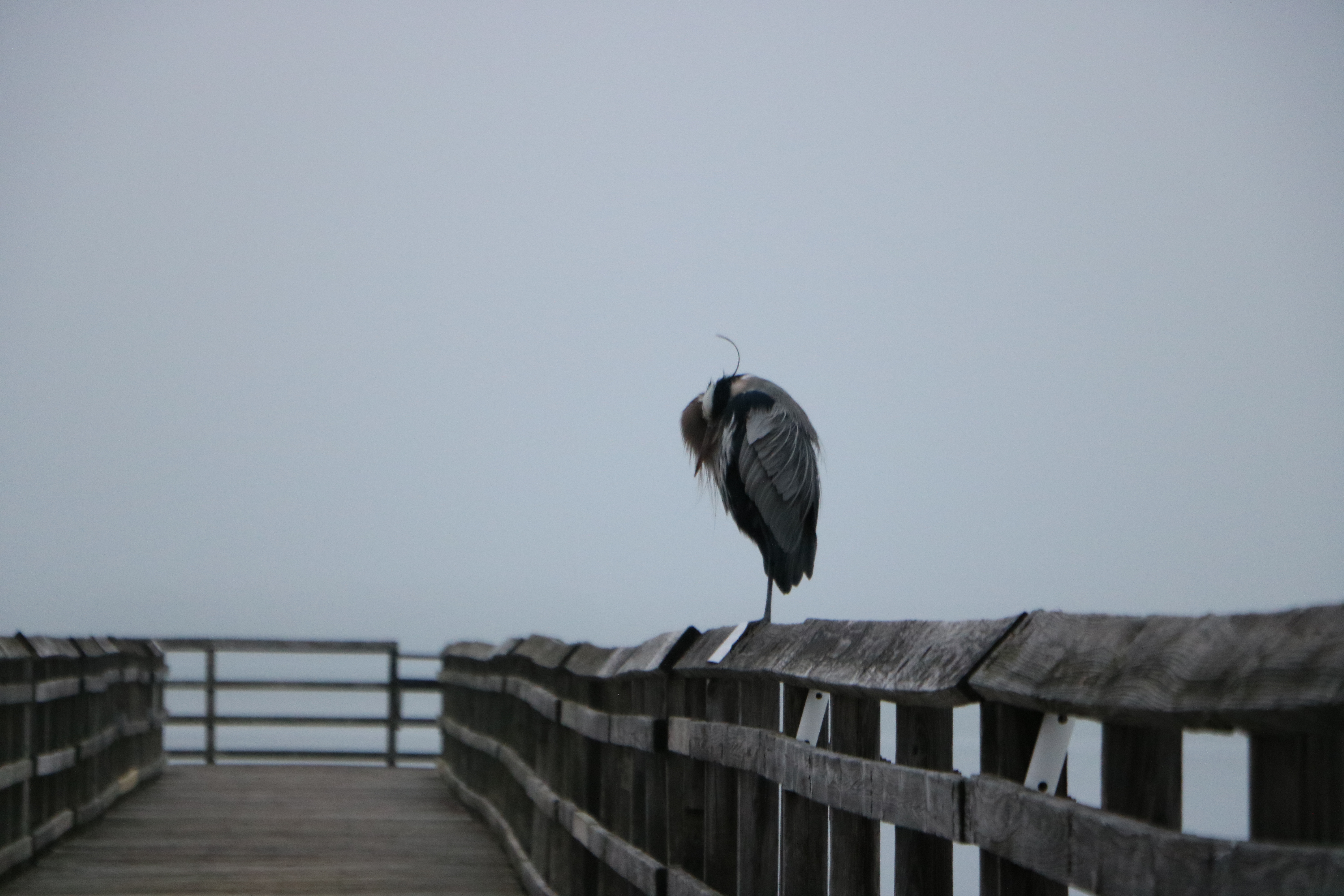
I could see the first twenty feet of railing, the weathered planks under my boots, and the heron. He was standing on the rail near the end—one leg tucked, feathers ruffled in the cold, beak closed. Beyond him, nothing. No horizon. No sunrise. No color. Just gray dissolving into gray, and a bird who didn’t seem to mind.
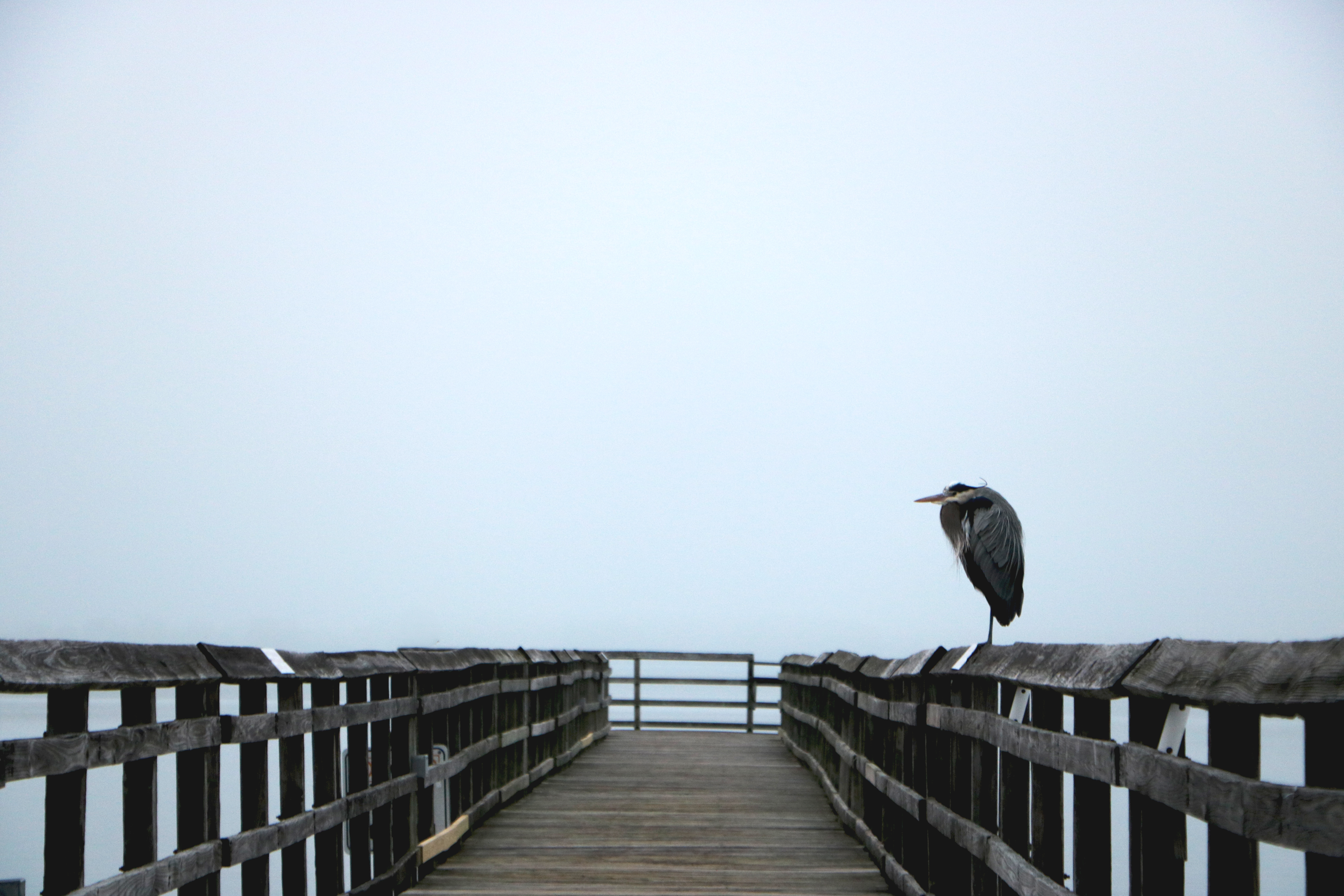
I took his picture because I couldn’t stop staring at him. He wasn’t fishing. He wasn’t scanning for threats. He wasn’t going anywhere. He was just standing on a pier that, as far as either of us could see, led nowhere… and he was fine with that.
I was not fine with that.
I’ve been a planner my whole life. In Mrs. Feldman’s class at Tecumseh Elementary, I wrote an essay about my future. I would marry at twenty-two, like my mom. I would have my first child by twenty-eight, like my mom. I named all my children. I could picture them—dark hair, olive skin, playing in the front yard while I watched from the porch swing.
There was no contingency plan. There was no “what if it doesn’t happen” paragraph at the end. There was no uncertainty because I was a girl, and girls get to dream in certainties.
I carried that essay in my heart for decades, even after the plan stopped matching the life. At thirty-four, I cried through my birthday because the children I’d named still hadn’t arrived. I wished on magnolia buds for a promise that they would. I built two columns on a legal pad of my life—one where Charming chose me, one where he didn’t—and I stacked support for the column I wanted to win.
I have been, for as long as I can remember, grasping for certainty. Reaching for the next man, the next plan, the next version of the dream that would finally deliver the life I’d outlined in Mrs. Feldman’s class. And every time God didn’t deliver it on my timeline, I directed my grief upward as accusation.
Why won’t You give me this? You know the desire of my heart. You put it there.
I spent my thirties angry at God. Not loudly, not heretically—just a quiet, simmering resentment that the life He had supposedly planned for me looked nothing like the one I had planned for myself. Every baby in a woman’s arms at church was a reminder. Every pregnancy announcement was a wound. Every birthday was another year outside the strategic plan, and I blamed the Strategist. I could not see I should only be mad at myself for drafting a blueprint God never signed… then holding Him accountable for not building it.
Sunday’s sermon was about Biblical generosity from 2 Corinthians 8 and 9. Pastor Colin was walking through what it means to give freely, to hold loosely, to trust that God provides. It was a good sermon. It wasn’t the part that wrecked me.
Somewhere in Colin’s lesson, almost as an aside, he touched on idols. The things we place before God. The things we grip so tightly that our knuckles turn white and our hands can’t receive what He’s actually offering. It was a passing comment, maybe thirty seconds of the sermon. It landed like a freight train.
Because I saw it.
The idol was never a man. It wasn’t Charming or anyone who came after. The idol was the dream—the blueprint, the essay, the plan. Husband by this age. Children by that age. Family by this deadline. The porch swing. The front yard. The dark-haired babies with olive skin. I had built an altar to a future that God never promised me, and I had worshipped there for twenty years.
And every man who walked into my life became the vessel I tried to pour the dream into. If he fit the mold—if he could unlock the husband and the daughter and the baby-making—then he was the answer. I was in such a hurry to force the fantasy that I ignored every red flag that waved in the wind because the flags were standing between me and my idol, and I wanted my idol more than I wanted the truth.
I put the dream above God. And the dream shattered.
I’ve written before about Dabrowski’s Theory of Positive Disintegration—the idea that growth doesn’t come through stability but through falling apart. That the old structure has to come down before a stronger one can rise. I’ve written about the Potter and the clay, about being taken apart by hands more skilled than mine. I’ve written about stewarding suffering, about how thin the line is, about how some of us almost become frozen photographs.
I’ve written around and through a month that I can’t fully tell you about yet. What I can tell you is this:
I am in the most uncertain season of my life.
I don’t know what next month looks like. I don’t know what next week looks like. The pier in front of me disappears into fog, and there is no visible end, no sunrise on the horizon, no color breaking through. Every plan I made has been unmade. Every certainty I clung to has been peeled from my fingers.
And for the first time in my life, I am not angry at God.
That’s the part that surprises me. In my thirties, far less pain than this sent me spiraling into doubt. I questioned heaven at my grandmother’s funeral. I pulled away from church. I asked, “What if there is no God?” on this very blog, publicly, because I needed the bravery to say it out loud. Smaller storms capsized me because I was standing on a foundation made of my own plans, and when the plans failed, the foundation crumbled, and I blamed the One I thought was supposed to be holding it together.
This time, the storm is worse. Categorically, measurably, incomparably worse. And I feel zero percent angry at God.
Not because I’m numb. Not because I’m pretending. But because somewhere between thirty-five and forty-three, I stopped standing on the blueprint and started standing on the Rock. I know—I know—that He hasn’t ceased being my safe place. Not for one second. Not on the worst night. Not in the thickest fog.
I never ask for these seasons. Nobody signs up for suffering, for grief, for the kind of uncertainty that makes you forget what certainty even felt like. But this is where God is most at work. This is where I am most reliant on Him. Not because I’m strong enough to choose reliance, but because everything else I relied on has been stripped away, and He’s the only thing left standing.
He is still a good God, doing good things in my life. Even now. Especially now.
In my twenties, I wrote the plan. In my thirties, I mourned the plan. In my forties, I’m learning to release it.
I spent months in a defensive stance—bracing, flinching, waiting for whatever would come next. And what came was worse than what I imagined. But something is shifting. I don’t know when it started. Maybe this morning, or another morning, standing in the fog. Maybe Sunday, sitting in the pew while a sidebar about idols tore through my chest. Maybe it’s been building quietly through every sunrise I’ve dragged myself to since the year turned.
I’m starting to breathe again. I’m picking up my shoulders. I’m not running and I’m not fighting. I’m standing. In the uncertainty. With no visible horizon and no plan and no deadline and no essay from Mrs. Feldman’s class to tell me what comes next.
I’m rising. I’m letting go of delusions and dreams. And I’m grasping tight to God’s gracious hand. The one that was always there, even when my hands were too full of idols to reach for it.
The heron stood on that railing for a long time last week. The fog never lifted while I was there. The sun never appeared. The pier kept disappearing into nothing.
He didn’t leave or fly to a clearer spot or feel the need to see the end of the pier to trust that it was there.
I think that’s what faith looks like when you strip away the plans, the timelines, the dreams you dressed up as prayers. It looks like standing on a foggy pier with no visible destination and being—not fine, exactly. Not comfortable. But held.
The pier goes somewhere. I can’t see where. And for the first time, I’m not trying to.
 Writer's Growth