Today was the last day of summer, and it didn’t sneak up on me. When you journal every morning and start by writing the date in the top right corner of every page, you feel the interconnectedness of it all. So despite an already packed day ahead, I made sure to position myself in my sanctuary to welcome the dawn of my last official day of summer vacation.
Looking back at the rest of the day, it doesn’t sound much like vacation—bringing Jack his favorite Hardee’s country fried steak biscuit, training teachers for NoRedInk, couples counseling with Tony, then driving to Richmond for an in-person training that meant missing the actual first day of preservice at Yorktown Middle School tomorrow. But maybe that’s exactly why I needed to start with a sunrise sea glass stroll at Fort Monroe Beach.
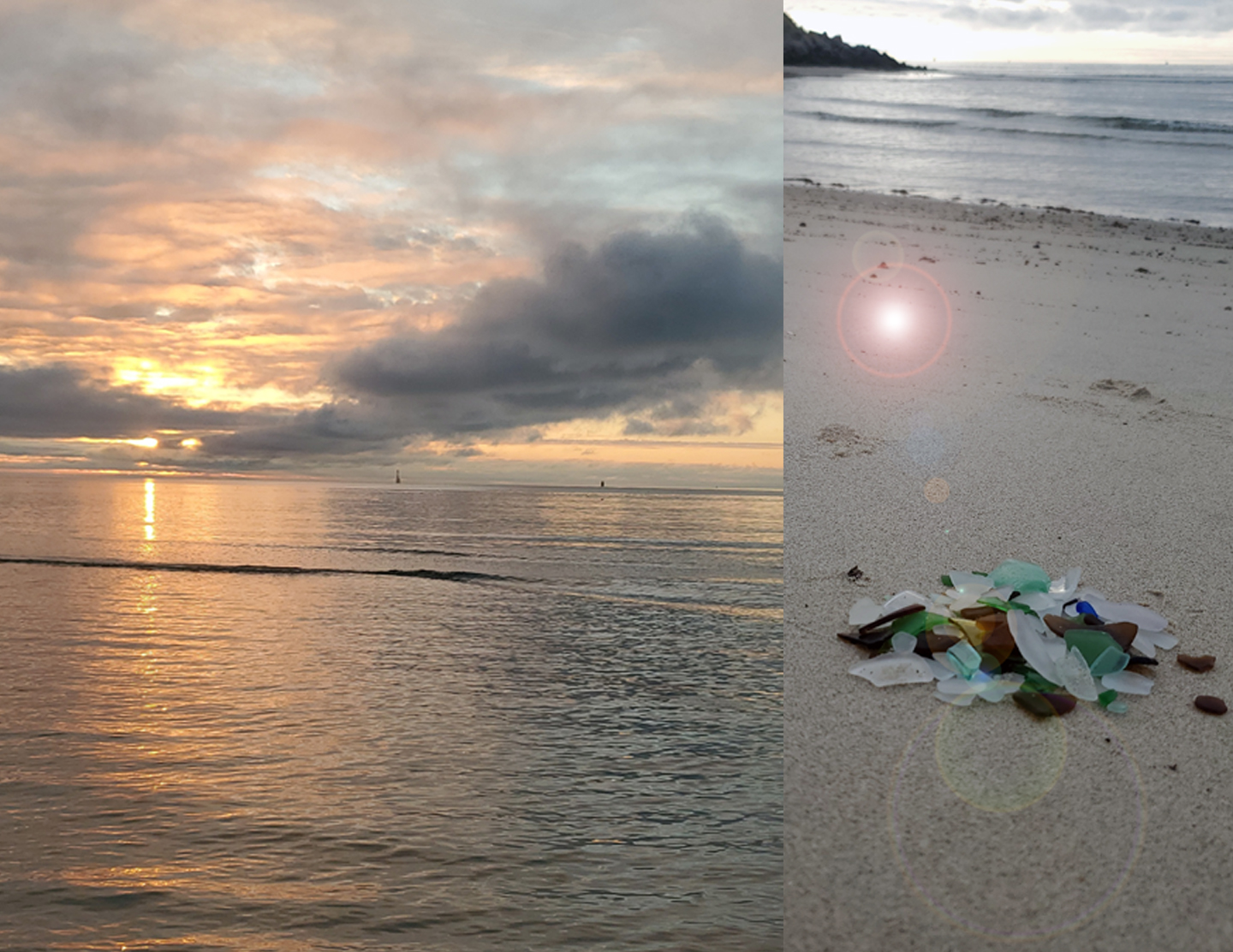
I was there well before six, in time for low tide when the sea glass picking is at its prime. I wasn’t alone—too many cranes and gulls to count. Just when I was playing that B minor chord on my ukulele, singing “Tide take me out to the bay / past the waves where dolphins play / and as I watch them swim away / I see the best things can’t remain the same,” a lone dolphin popped up to remind me of God’s timing in seasons.
I collected more sea glass than I have in the past month. It was the perfect last day of summer.
The Teacher I’m Becoming
In a couple of weeks, I’ll be returning to teach advanced sixth grade English at Yorktown Middle School, continuing with the teaching contract I took on midyear in January. I still feel a bit like I’m pretending to be a sixth grade teacher. I was so good at high school, and as people read this, I want them to think, “It doesn’t matter that this isn’t her experience area because she’s a quality educator.”
But this year, I’m carrying a different kind of fear. Since I’ve come out publicly about my mental illness, will there be pushback? Will there be a student or parent who complains when I lose my temper—which I’m bound to do because we’re all human? The classroom is usually a safe place for me. I’m really at my best when there are 28 witnesses.
Here’s what I’ve learned about myself as an educator: I readily own my ADHD symptomology because I can model for my students exactly how I learned to accommodate for myself without being diagnosed until I was 34.
The Accommodations I Built Without Knowing
Looking back, I can see all the strategies I developed as a struggling student that later became the foundation of my teaching practice:
Eliminate distractions. No extra stuff out on my desk, only what I needed. My journal was never considered “extra”—I would freewrite or write poetry whenever I finished before classmates. I needed this for dead space.
Take notes on everything. I had to take notes if any instruction was taking place, even if the teacher wasn’t guiding this process. At church, our pastor gave us sermon outlines with blanks to be filled in. As a teacher, I naturally provided similar “guided notes” as accommodations for my students. I couldn’t expect myself to pay attention, unguided, for 90 minutes at church. I couldn’t expect more from my students in ELA class.
Sit properly to avoid fidgeting. Distractions disappear when you can’t see your feet or your bookbag and its contents.
See directions to follow them. Oral instructions were often lost on me. I often got in trouble for asking a classmate what we were supposed to be doing because I’d been writing a poem for the last twenty minutes, waiting for others to catch up. Every instruction I give my students is also on the projector in writing, not surprisingly.
Manage digital distractions. When the world digitized, I quickly learned to shut out of all unrelated tabs when working on a task. If not, those tabs called to me. I would lose myself to them.
Write to remember. This year, through couples counseling, Tony and I discovered that if I grabbed my journal during heated debates, I could write down his thoughts and circle places I wanted to respond. I didn’t have this strategy as a child, so I often cut people off, afraid I wouldn’t remember what I wanted to say. Now I have that resource for other meetings, like parent-teacher conferences.
When I became a teacher, I naturally created a classroom where students with ADHD have the supports necessary to thrive because I implemented all the coping strategies I’d developed as a middle schooler. I’ve been owning that ADHD diagnosis for eight years.
I’ve only just come out about my three-decade battle with bipolar disorder.
The Question That Keeps Me Up
Will I ever feel safe admitting to my students that I have bipolar disorder?
I shared my blog with a few young mental health advocates in my classes this past spring, but even then, I wondered if I left myself too exposed. I had a student whose father had bipolar disorder and had really imploded her life. I wanted to encourage her, give her hope and guidance, but the English classroom isn’t that place.
Maybe I’ll start a club this year, borrowing my husband’s and my podcast title: The Wellness Spectrum. I could practice some of the skills I’m learning in my peer support specialist certification program. Our club could focus on different topics, gather resources, and petition our district to formally endorse mental health awareness month. Maybe that could position me to meet the future board members of Virginia’s first DBSA chapter. I can’t start it alone—I’m going to need a treasurer and at least one other board member besides Tony and me.
Working With, Not Against
Here’s what I wish I could explain to my students, if I were as comfortable owning my bipolar disorder as I am my ADHD: I don’t battle with my illness anymore. I work with it.
It’s cyclical. Starting in college, I got depressed every winter like clockwork. Only I didn’t see the pattern until I was looking for it. I’d get put on an antidepressant, and that would ramp up the mania. I used to get depressed just thinking about winter approaching, fearing this awful span of months when I wouldn’t be my best self.
Now I understand that in winter, when the days are shorter, if I still rise and set with the sun, I’m just right. I hibernate a little. I have less energy. I practice stillness activities. When everything starts to bloom in spring, so do I. Summer is my bliss.
Before this past calendar year, I didn’t see the importance of maintaining the same sleep routine year-round, all four seasons, weekday or weekend. Now I know that working with my natural cycles instead of fighting them is the key to stability.
The Tide Takes Me Out
As I sit in this Richmond hotel room, reflecting on that pre-sunrise moment, I keep thinking about that dolphin’s perfect timing. There I was, singing about how the best things can’t remain the same, and God sent a messenger to remind me that seasons are sacred, transitions are necessary, and some changes are blessings in disguise.
I collected more sea glass this morning than I have in a month. Each piece had been tumbled and smoothed by forces beyond its control, transformed from sharp-edged refuse into something beautiful and sought-after. The ocean didn’t fight the glass—it worked with it, patiently, persistently, until rough edges became smooth treasures.
Maybe that’s what this year will be about. Not hiding the parts of me that feel sharp-edged or potentially dangerous, but trusting that the right environment—a classroom built on understanding, a district that values mental health awareness, students who see their teacher’s authenticity as permission to be human—can smooth even the most jagged pieces into something beautiful.
The tide is taking me out past the familiar shores of hiding. Past the waves where dolphins play and remind us that the best things really can’t remain the same.
Summer is ending. The teaching year is beginning. And for the first time, I’m not trying to be someone I’m not. I pray, in that, I’ll be light and hope to these little ones.
What parts of yourself are you still keeping hidden that might actually be your greatest teaching tools? Sometimes the very things we’re most afraid to reveal become the bridges that help others feel less alone.
 Writer's Growth