I’ve donned elaborate costumes four decades straight. On Halloween when I change my look, it alters my attitude, mindset, speech, and behaviors. Acting comes so easy to me, in fact, I’d rather don a perpetual Halloween costume than undergo character transformation. Can we align with the character we want, permanently?
Every Halloween living in Hampton, I spent the holiday with my brother’s family, racking up memories parading around the neighborhood with candy sacks. It’s the Palma family tradition, and I was a Palma.
My new boyfriend and his twelve-year-old didn’t have any long-standing day-of traditions, so I naturally high-jacked the holiday, requiring our attendance at my brother’s house for dinner and a costumed lap in the neighborhood, just like we always do. Palmas don’t like change, we always say.
I had unknowingly ruined the concept of a plan Tony’s daughter Cali had to go trick or treating in themed costumes with another friend. When she brought it up again in mid-October, I told her that six weeks was enough time to have accepted the plan and moved on. And when it slipped out that this friend was the son of a woman Tony used to date, my walls went up completely. No one would change my mind.
I would hold tight to family traditions to reaffirm our Halloween plans, but my emotional baggage was showing. Did Tony see? I kept praying, “God, let this be the one for me.”
The next night, I overheard a conversation. Tony was trying to explain to a child that I was emotionally damaged. At the time, the phrase infuriated me. I was unable to see that the label fit. Now, hearing the words “emotionally damaged” makes feel compassion for all of us here at adult swim, drowning in our shortcomings, praying the next relationship to be a healthy one.
Let’s face it, early life is a series of comedies, rightly and neatly wrapped at the end. The older we get, the more tragic endings we accumulate, and these change us in ways we don’t notice. We’re so externally focused on securing the right partner to match our idiosyncrasies, we fail to consider the most logical path to finding love would be to resolve those idiosyncrasies.
The situation of Tony crossing paths with an ex-girlfriend should have given me no pause. He’d never given me any reason not to trust him, and Cali had a long-standing friendship at stake. I’m not sure which motivation was greater: avoiding an external change, like how we spend Halloween, or avoiding an internal change, like not making my current partner pay for a past partner’s mistakes.
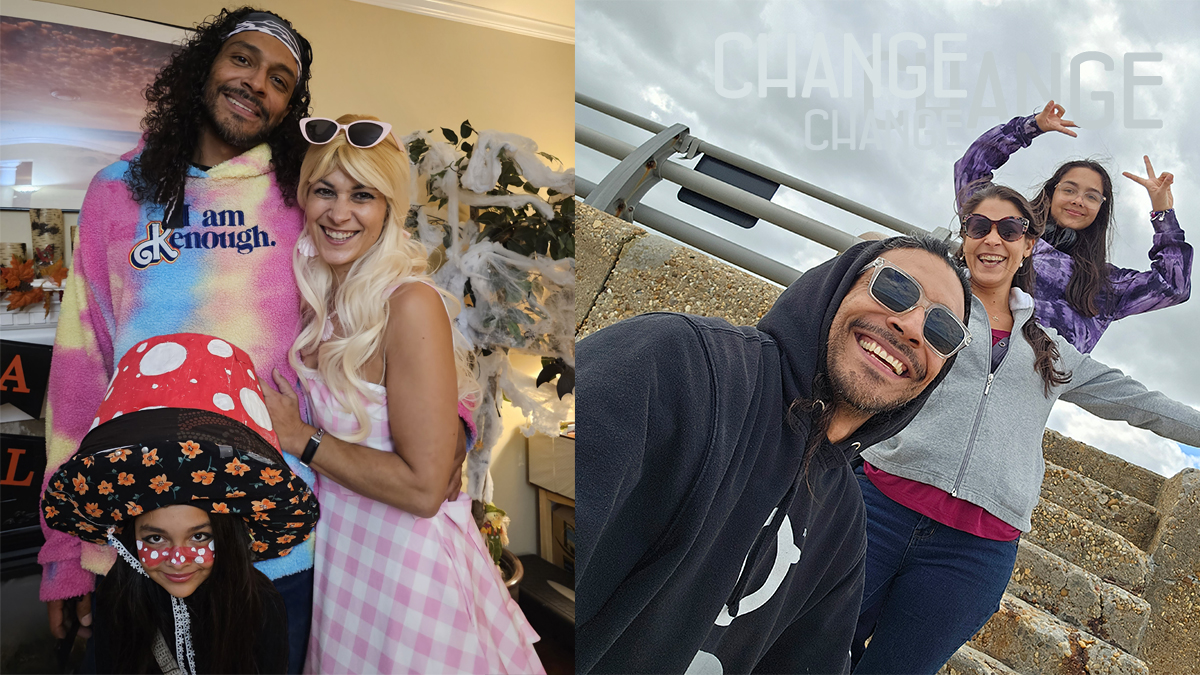
In the end, we donned elaborate costumes. Cali abandoned her original idea with her friend in favor of becoming a mushroom, and Tony’s “I am Kenough” hoodie inspired our selections. In typical fashion, I modified my mindset, speech, behavior, and attitude to become Barbie. I could see the difference between myself and the character I wanted to be.
Ken, Barbie, and Mushroom went to my brother’s house, as planned. We had dinner and did a lap around the neighborhood. Barbie’s smiling in the pictures, but I’m acting. Tony, Cali, and I were not okay. And we wouldn’t be okay until I changed faces permanently.
That would take time. But how much? Would I change fast enough to keep this new, little family?
With last week’s blog, I included a poll asking if you believe people can change core character traits? A couple days later, one of my favorite podcasters weighed in on the same topic. Like me, Jay Shetty believes that deep-seated change is possible. We can change a habit in a month, adapt to a change in ninety days, but seeing a value or norm change can take years.
The first secret to get Tony to marry me unlocked when he pointed out my shortcomings, and I was finally willing to accept his criticism and do something about it. “[People] change when they want to change,” Jay Shetty said last week on On Purpose. “When it impacts them so badly that they’re not changing, that’s when they’ll change.”
There came a a crossroads when I was forced to take accountability for what changes were required and why. Do you find yourself defending your idiosyncrasies and protecting your faults? Are you so committed to the stability of staying the same that you’re missing out on a better version of yourself?
Being willing to change predicates itself on accepting you might be wrong. At any given time. About any given thing. When my perception of life intersects with Tony and Cali’s, it doesn’t just change my perception of the world; it changes my perception of myself.
I can see the difference between myself and the person I want to be, like a character on Halloween.
God was gracious. He prepared Tony and Cali to guide me on a transformational journey into wife and mother. The truth is, I don’t think I’d have made any changes without being in the context of this family. In the prior decade living alone, I easily avoided the triggers that make me difficult to live with. Bumping up against others in daily life, I saw attitudes and behaviors that weren’t working for me. I stopped asking God for someone else and started praying for character evolution.
That’s the first step. Embrace change, even if your family mantra rejects it. For my next five posts to have any impact, you must accept you could be wrong, you might need to change, and that might be the best first thing you ever do. Abandon the perpetual Halloween costume with me.
Enjoy this read? Leave a *Like* here or on Facebook. Subscribe and share.
Follow on Instagram or Twitter @laurajoyramos, elevating social discourse on an intersection of mental health, wellness, and relationships.
See you back next week for our second secret to getting broken people (like me) down the aisle.
 Writer's Growth